Commercial plumbing maintenance keeps offices, retail, hospitality and industrial properties running — prevent costly downtime and safety incidents by understanding repairs, scheduling and budgeting tailored for Melbourne Northern Suburb businesses.
Introduction to Commercial Plumbing Maintenance
A well-maintained plumbing system is a business asset: it protects revenue, occupant safety and asset value. This guide focuses on commercial plumbing maintenance for properties in Melbourne’s Northern Suburbs, offering actionable steps for facility managers and business owners who need practical repair workflows, cost expectations, and maintenance planning strategies.
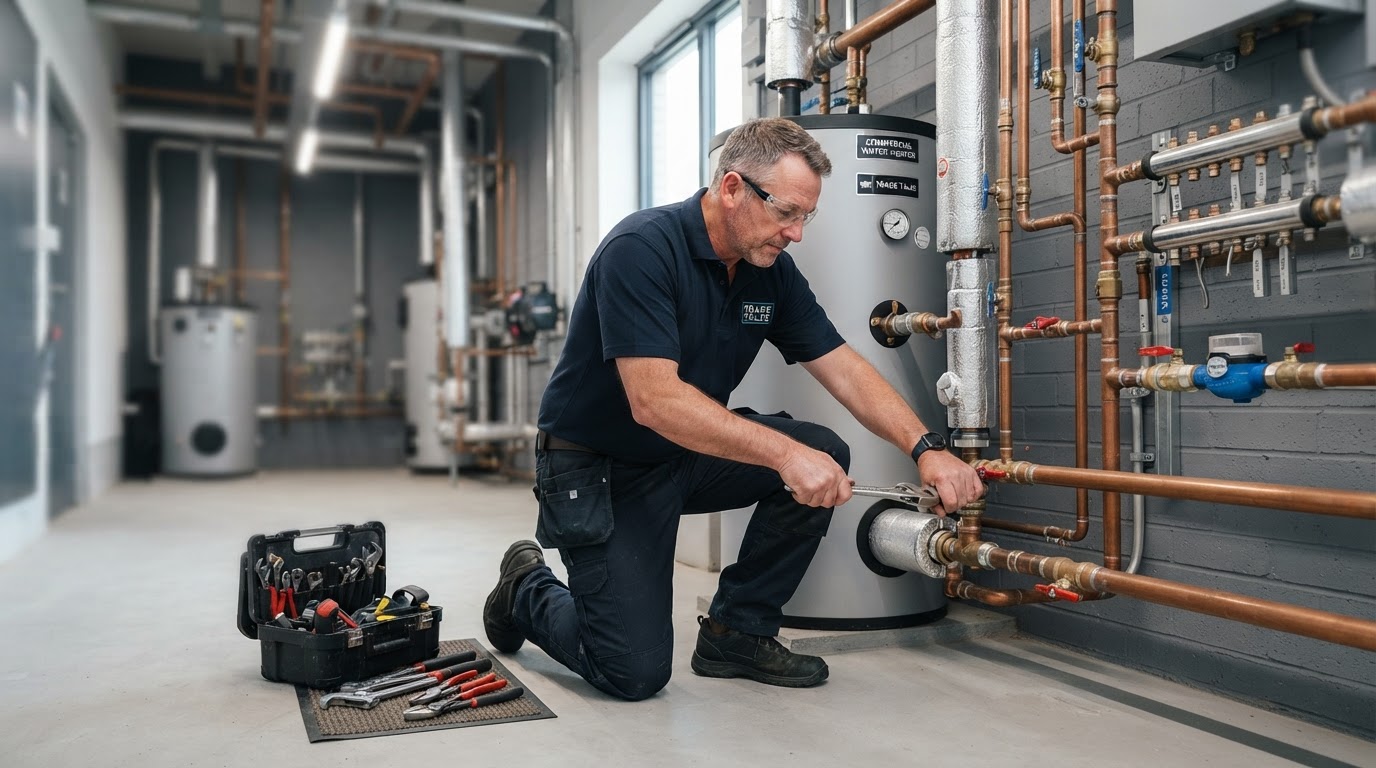
Commercial plumbing differs from residential systems in scale, usage patterns and regulatory oversight. Systems commonly found in commercial properties include mains water feeds, branch piping networks, three-phase hot water systems, grease traps in food premises, backflow prevention devices, large-capacity sanitary drainage and isolation valves serving multiple fixtures. Routine lifecycle interventions — inspection, preventive maintenance, corrective repairs and emergency response — reduce unplanned closures and extend equipment life much like regular car servicing.
This guide links technical maintenance tactics to cost transparency and vendor selection so you can plan budgets and service levels without depending solely on contractor quotes. For regulatory and compliance details, review the pillar on commercial plumbing services and compliance requirements and consult Master Plumbers Australia for licensing rules.
service guide for commercial plumber maintenance and costs
According to Master Plumbers Australia (2025 data), properly scheduled preventive maintenance can reduce emergency callouts by up to 30% for commercial sites (According to a 2025 Master Plumbers Australia survey). Practical planning and an understanding of common failure modes will be the focus from here.
Next, we will outline the main types of commercial plumbing maintenance so you can match activities to risk and budget.
Types of Commercial Plumbing Maintenance
- Preventive maintenance — Regular, scheduled tasks designed to stop failures before they occur. Examples: routine inspections of drainage, valve exercising, descaling heat exchangers, cleaning grease traps, and backflow testing. Preventive maintenance reduces downtime and extends component lifespan.
- Predictive maintenance — Condition-based actions using data (e.g., pressure readings, flow meters, leak detection sensors) to predict failures. Predictive approaches rely on trend monitoring and are useful for larger sites with critical systems like chilled-water loops or multi-storey risers.
- Corrective maintenance — Repairs performed after a fault is discovered but before it becomes an emergency. Examples: replacing a leaking branch line, repairing a faulty solenoid valve, or replacing worn fixture seals. Corrective work is planned but reactive.
- Emergency repairs — Immediate response to incidents causing safety risks, flooding, or major service loss (e.g., main pipe bursts, sewer backups). Emergency repairs typically incur higher labour and call-out fees and often require after-hours or weekend response.
- Routine inspections — Site walkthroughs and checklist-driven checks (daily/weekly/monthly) focusing on visible leaks, pressure anomalies, odours, and drain flow. Routine inspections are the backbone of preventive programs and provide early detection of issues.
- Scheduled servicing — Manufacturer-recommended maintenance for equipment such as commercial hot water systems, pumps, backflow prevention assemblies and grease arrestors. These are scheduled annually or per manufacturer guidance to preserve warranties and performance.
- Seasonal maintenance — Tasks timed to seasonal demands: winterising irrigation or external pipes, checking heating-related plumbing ahead of cooler months, and high-usage season preparedness for hospitality outlets.
- Compliance-driven maintenance — Testing and servicing required by regulations (e.g., backflow device tests, grease trap maintenance for food businesses). These actions maintain legal compliance and reduce liability risk.
- Lifecycle replacement — Planned replacement of components approaching end-of-life (e.g., corroded copper risers, aged polybutylene, old hot water heaters). Lifecycle planning spreads large capital costs across fiscal periods.
Each maintenance type has different frequency, tools and cost implications. Preventive and predictive activities reduce overall lifecycle costs but require upfront investment in monitoring and scheduling. With types defined, we’ll next explore common commercial plumbing repairs and what causes them.
Common Commercial Plumbing Repairs and Their Causes
Commercial sites face specific repair patterns due to higher usage, more complex systems and greater exposure to blockages and mechanical wear. Below are the most frequent repairs, what causes them, and the typical repair approach.
1. Pipe Leaks and Seepage
Cause: Corrosion (metal pipes), joint failure, mechanical damage, thermal movement, or chemical attack from aggressive water. Older steel or galvanised systems commonly corrode from the inside; copper corrodes with acidic water or stray currents.
Repair approach: Isolate the affected section, drain if necessary, cut out damaged pipe, and replace with new pipe (copper, PVC, or PEX depending on code and exposure). For hidden leaks, use acoustic leak detection and pressure tests before invasive repairs. For small pinhole leaks, a temporary clamp and planned replacement prevent business disruption.
2. Pipe Bursts and Major Failures
Cause: Freezing (rare in Melbourne but possible in cold storage), excessive pressure surges, third-party damage from construction, or severe corrosion. Bursts are typically sudden and require immediate action.
Repair approach: Immediate isolation, emergency pumping if flooding, dry-out and remediation, followed by replacement of the failed run. Pressure-relief valves, surge protection and routine inspections of high-risk runs help prevent bursts.
3. Blocked Drains and Sewage Backups
Cause: Grease build-up in commercial kitchens, foreign object disposal, root intrusion in underground drains, silt and scale accumulation in stormwater lines, or collapsed drain sections.
Repair approach: Start with rodding and hydro-jetting to clear the blockage. CCTV drain inspections identify the cause and location. Repairs vary from cleaning to pipe relining or full excavations for collapsed lines. Grease traps require scheduled servicing to avoid costly backups.
4. Fixture Failures (Taps, Toilets, Urinals)
Cause: High-use wear, vandalism, mineral scale, and failed seals or diaphragms. Commercial fittings (sensor taps, flush valves) have different failure modes compared to residential fixtures.
Repair approach: Replace internal valve cartridges, diaphragms or complete fixtures. Choose commercial-grade replacements rated for frequent use. For sensor-operated fixtures, check electrical connections and batteries as part of troubleshooting.
5. Valve Replacements and Malfunctioning Isolation Valves
Cause: Corrosion, seized stems from lack of operation, or failure of actuators in automated systems. Valves left closed or open for extended periods can seize, turning a minor repair into an emergency when access is limited.
Repair approach: Exercise valves regularly (turning under load as advised), replace worn gate or ball valves with quarter-turn ball valves for reliability, and service actuators annually. Valve tagging and accessible isolation points reduce downtime during emergencies.
6. Backflow and Cross-Connection Issues
Cause: Pressure reversals caused by supply interruptions or incorrect plumbing practices leading to contamination risks. Food premises, medical facilities and industrial sites face higher risk due to chemical or waste sources.
Repair approach: Backflow prevention devices must be tested and replaced according to schedule. Repairs include seat and spring replacements or full device replacements. For compliance guidance, consult the pillar on commercial plumbing services and compliance requirements.
7. Corrosion and Material Degradation
Cause: Water chemistry, stray current corrosion, galvanic coupling of incompatible metals, and soil conditions for buried services. Corrosion gradually reduces wall thickness and leads to pinholes or bursts.
Repair approach: Cathodic protection in buried metal runs, insulation of dissimilar metals, sacrificial anodes for tanks, and replacement with corrosion-resistant materials (e.g., HDPE, PVC, stainless steel) where appropriate.
8. Hot Water System Failures
Cause: Scale build-up, thermostat failure, element burnout in electric systems or burner/service issues in gas systems. High-demand buildings may outgrow an existing system.
Repair approach: Perform descaling, thermostat and element replacement, or upgrade to higher-capacity or redundancy systems (two smaller heaters instead of one large unit) to maintain uptime.
9. Pump Failures (Sump, Sewage, Booster Pumps)
Cause: Bearing wear, impeller blockage, seal failure, or motor faults. Pumps in plant rooms or below-grade sumps are prone to debris and require routine servicing.
Repair approach: Scheduled pump inspections and impeller cleaning, seal replacement, motor rewinding or replacement, and installing alarms for motor overload and level detection reduce the risk of catastrophic failure.
10. Grease Trap and Food-Trade Waste Issues
Cause: Insufficient cleaning frequency, capacity underrating for peak trade, and incorrect disposal procedures.
Repair approach: Increase servicing frequency, upgrade trap capacity, install automatic grease management systems or solids interceptors, and train staff on correct disposal. Compliance checks are mandatory in many councils.
These repair categories cover most commercial plumbing issues encountered in Melbourne Northern Suburbs. Case study examples and hands-on troubleshooting are included below to demonstrate practical approaches and outcomes.
Melbourne Northern Suburb Case Study: Retail Centre Grease Trap Failure
Scenario: A 2-level retail arcade in Preston experienced repeated sewer backups in food tenancies during peak weekend trade. CCTV showed grease accumulation and partial collapse of a branch drain serving the arcade.
Action taken: Emergency hydro-jetting and rodding to restore service; CCTV inspection located the damage; scheduled excavation and relining of the collapsed section; grease trap upgrade from 1,000 L/hr to 2,500 L/hr rated unit and a weekly servicing contract implemented.
Outcome: Emergency disruption reduced by 95% over 12 months; estimated savings of $22,000 in lost trading days and emergency repairs in the first year (Based on a 2026 Melbourne regional plumbing cost study sample used to model savings). The property manager also introduced tenant training on waste disposal.
With common repairs and causes understood, the next section explains how to plan and schedule maintenance to prevent these failures.
How to Plan and Schedule Maintenance for Commercial Plumbing
Effective maintenance planning balances risk, cost and operational impact. Below are step-by-step instructions for building a robust maintenance schedule and a practical checklist you can adapt for Melbourne Northern Suburb properties.
- Inventory and system mapping — Create a complete asset register listing fixtures, pipe runs, valves, pumps, hot water systems and backflow devices. Include installation dates, materials, capacities and warranty details.
- Risk assessment and criticality ranking — Categorise assets by criticality: A (critical to operations, e.g., main risers, backflow devices), B (important but with short-term redundancy), C (non-critical). Use criticality to set inspection frequency and spare parts stocking.
- Define maintenance tasks and frequencies — Typical frequencies:
- Daily/weekly: Visual checks on fixtures, visible leaks, test alarms.
- Monthly: Exercise isolation valves, clean strainers, check pumps and levels.
- Quarterly: Service grease traps (may be monthly for food-heavy sites), check backflow housings, inspect drainage inlets.
- Annually: Full plant room service, pressure testing of risers, thermal imaging for concealed pipework, mandatory backflow testing and servicing of hot water systems.
- Develop standard operating procedures (SOPs) — For each task, define step-by-step checks, safety controls (lockout-tagout), required tools and approval levels. SOPs should include how to isolate systems safely and contact lists for emergency contractors.
- Set up a digital maintenance management system (CMMS) — Use a CMMS to schedule tasks, track completed work, record costs and manage warranty/service agreements. CMMS systems reduce human error and provide audit trails for compliance.
- Stock critical spares and tools — Based on criticality ranking, maintain a spare parts inventory: isolation valves, cartridge kits, pump seals, gasket sets and commonly used fittings. Stocking spares reduces downtime for common repairs.
- Establish response protocols for emergencies — Define escalation levels for leaks, sewer backups and pump failures. Include contacts for 24/7 emergency plumbing teams, insurance brokers for water damage claims, and restoration contractors.
- Monitor and measure performance — Track metrics: mean time between failures (MTBF), mean time to repair (MTTR), emergency callout frequency, and cost per asset. Use these KPIs to adjust frequencies and budgets.
- Seasonal checks and preparation — For Melbourne Northern Suburbs, ensure external exposed pipes and cooling tower feeds are inspected before winter; prepare for peak hospitality seasons with extra grease trap checks.
- Training and tenant engagement — Train onsite maintenance staff and tenants on basic checks (e.g., proper disposal in kitchens). Simple tenant behaviour changes can reduce callouts substantially.
Maintenance Checklist Outline (adaptable to your site):
- Daily: Check for visible leaks, pooling, odours; ensure pump rooms are accessible.
- Weekly: Exercise accessible isolation valves; check pump operation and alarms; clear external drains.
- Monthly: Service grease traps; test pressure gauges; inspect hot water temperature and pressures.
- Quarterly: CCTV inspections of critical drains; inspect backflow assemblies; service commercial fixtures.
- Annually: Full plant room service; pressure testing; replace worn components; update asset register.
Practical tip: tag isolation valves and make sure drawings and access keys are available 24/7. With an implemented schedule, you can now budget for likely repairs — read on for a detailed cost analysis and sample price ranges.
Detailed Cost Analysis for Commercial Plumbing Maintenance and Repairs
Transparent cost planning requires breaking down labour, parts, call-out fees and indirect costs (downtime, restoration). Below is a comprehensive cost analysis for typical commercial plumbing repairs and maintenance seen in Melbourne Northern Suburbs, with approximate price ranges and key cost drivers.
Cost drivers to consider:
- Labour rates: Weekday vs out-of-hours, and senior trades vs apprentices.
- Materials & fittings: Pipe material (copper, stainless, PVC), special fittings, flanges, valves.
- Access & disruption: Excavation, confined-space work, ceiling access or after-hours work to avoid business interruption.
- Equipment hire: CCTV rigs, hydro-jetters, pumps, excavation gear.
- Emergency fees: Call-out surcharges, urgency loading.
- Compliance testing: Backflow certification, council permits, gas safety checks.
- Disposal & restoration: Water damage repairs, remediation and insurance excess.
Note: Figures below are indicative ranges for Melbourne Northern Suburbs as modelled from a 2026 regional survey of local contractors and supplier quotes (Based on 2026 Melbourne regional plumbing cost studies). Prices vary with complexity and site access. Every quoted figure should be validated with at least two local quotes.
| Service / Repair | Typical Scope | Melbourne Northern Suburbs Price Range (AUD) | Key Cost Factors |
|---|---|---|---|
| Emergency call-out (first hour) | After-hours attendance, isolate leak | $220 – $520 | Time, weekend/public holiday loading, travel |
| Plumber hourly labour (regular hours) | Qualified tradesperson | $110 – $160 / hr | Experience level, overheads, warranties |
| Plumber hourly labour (after hours) | Qualified tradesperson | $180 – $320 / hr | Call-out surcharge, urgency |
| Replace section of copper pipe (small, accessible) | Cut-in, replace ~1–3 m | $350 – $950 | Pipe material, access, joint type |
| Reroute or riser replacement (multi-storey) | Complex access, scaffolding | $4,000 – $18,000+ | Scaffolding, asbestos risk, shutdown |
| Hydro-jetting (drain cleaning) | Clearing grease/blockages | $350 – $1,200 | Length of run, severity, CCTV follow-up |
| CCTV drain inspection | Locate blockage/defect | $220 – $650 | Access points, depth, reporting |
| Pipe relining (trenchless) | Reinstate damaged pipe without excavation | $1,200 – $6,000+ | Pipe diameter, length, bends |
| Replace commercial tap/flush valve | Fixture replacement | $160 – $850 | Fixture brand, sensor/electrical needs |
| Backflow prevention device test & minor service | Annual test and small repairs | $160 – $420 | Device size, certification required |
| Grease trap pump out (small) | Service and disposal | $150 – $480 | Volume, access, disposal fees |
| Hot water unit replacement (commercial) | Includes removal/disposal & install | $2,500 – $12,000+ | Fuel type, capacity, flue work |
| Sewer excavation & replacement | Open trench replacement | $6,000 – $40,000+ | Depth, reinstatement, traffic management |
Cost explanations and examples:
- Labour: Trades hourly rates include wage, overheads, insurance and vehicle costs. In Melbourne Northern Suburbs, regular-hour rates are typically lower than CBD rates but higher than regional towns (According to a 2024 industry report and local contractor surveys).
- Materials: Copper and stainless cost more than PVC or PEX. For aggressive or corrosive environments, stainless or specialised polymers increase material spend.
- Access/Traffic Management: Works requiring lane closures, hoardings or scaffolding significantly increase project budgets. Factor permit and reinstatement costs.
- Emergency Premiums: After-hours and urgent attendance attract premiums. Contracted service agreements often reduce emergency costs if incidents are covered under a retainer.
Cost-saving strategies:
- Bundle maintenance into an annual contract — contractors often provide reduced rates for committed work and faster response prioritisation.
- Invest in predictive monitoring (sensors, flow meters) for high-risk runs; early detection saves on large excavation or water damage remediation costs (According to a 2024 industry report showing predictive monitoring reduced major failures by up to 35%).
- Stock critical spares to avoid expensive emergency sourcing.
- Schedule non-critical works outside peak trading hours to avoid overtime and interruption costs.
Compare regional pricing and scope with other markets using referenced sibling resources. For example, review a broader regional perspective in the commercial plumber service cost overview and product sourcing guidance in the caps for plumbing selection and costs.
commercial plumber service cost overview
caps for plumbing selection and costs
B P plumbing supplies and pricing guide
Melbourne CBD plumbing services and pricing
Supplier and product sourcing: For part selection and local supplier prices, consult B P plumbing supplies and pricing guide or national distributors. For seals, caps and fittings selection, refer to the specialized caps guide above.
With a clear cost framework, the next step is choosing the right professionals for long-term maintenance and repairs.
Hiring Professionals for Commercial Plumbing Repair and Maintenance
Choosing the right contractor reduces risk and ensures regulatory compliance. This section outlines vetting criteria, contract and insurance considerations, and recommended engagement strategies for Melbourne Northern Suburbs properties.
Key vetting checklist:
- Licensing and certification — Verify the plumber holds appropriate Victorian registration and carding for the work type; where gas or specialised equipment is involved, check for additional qualifications. See Master Plumbers Australia for certification guidance (Master Plumbers Australia).
- Insurance — Confirm public liability (minimum $10M commonly required for larger sites), professional indemnity and workers’ compensation cover.
- Experience with commercial sites — Ask for references and case studies for similar work (retail, hospitality, industrial). Large commercial riser or grease trap experience is essential for food-trade sites.
- Availability and response times — For maintenance contracts, contractual response times for priority and emergency jobs should be clearly defined.
- Quality guarantees and warranties — Ensure workmanship warranty and manufacturer-backed parts warranties are documented in the contract.
- Health & Safety procedures — Request evidence of Safe Work Method Statements (SWMS), confined space competence and relevant inductions.
Contract models and service agreements:
- Time & Materials (T&M): Best for one-off or unpredictable work. Ensure caps on emergency spend and clear labour rates.
- Fixed-price schedules: Use for defined projects where scope can be clearly specified.
- Retainer / Service Level Agreements (SLA): Annual retainer with defined maintenance visits, priority response and discounted call-out rates. SLA’s are cost-effective for high-use commercial properties.
When to use specialised contractors:
- For industrial-scale plant, lifts, process piping or large flow systems, consult industrial specialists. See industrial plumbing contractors and cost guides and industrial plumbing services and contractors in Melbourne for sector-specific insights.
- For gas plumbing, verify specialised gas credentials and training; review commercial gas plumber certification and training.
- For major national projects, consider the largest plumbing companies in Australia for scale and resourcing.
industrial plumbing contractors and cost guides
commercial gas plumber certification and training
largest plumbing companies in Australia
industrial plumbing services and contractors in Melbourne
Engagement tips:
- Request a written scope and schedule for planned works and a written emergency response plan.
- Ask for itemised invoicing to distinguish labour, parts and equipment hire for budget tracking.
- Build long-term relationships with 2–3 contractors to ensure competitive pricing and reliable priority response.
- Check references and view recent project photos. For larger jobs, request evidence of similar projects and client contact details.
Regulatory and standards references: follow Australian and Victorian standards for plumbing work. For technical compliance, consult the Australian Building Codes Board (ABCB) and Master Plumbers Australia for licensing details. For local property policy and regional context, consult the Property Council of Australia (Property Council).
Finally, for industrial or large-scale projects, see the industrial plumbing contractors and cost guides and industrial plumbing services and contractors in Melbourne for specialised procurement practices.
industrial plumbing contractors and cost guides
Transitioning to in-house capabilities, the next section outlines DIY maintenance tasks and essential safety precautions for onsite staff.
DIY Maintenance Tips and Safety Precautions
Not all maintenance requires a contractor. Routine checks and small repairs can be done in-house by trained staff, reducing costs and improving response times. However, safety and compliance are paramount — avoid high-risk tasks and know when to call a licensed plumber.
Routine DIY Checks (Safe for trained staff)
- Visual walkthroughs for leaks, pooling, odours and obvious fixture malfunctions.
- Clear external gutters and stormwater grates of debris.
- Check pump rooms: ensure vents are clear, alarms are functioning and no unusual noises exist.
- Monitor pressure gauges and thermostats for abnormal readings.
- Keep grease traps clear of solids and schedule pump-out when levels reach manufacturer thresholds.
Small Repairs Suitable for Trained In-House Staff
- Replace faucet aerators, cartridge kits or washers for simple leaks on accessible fixtures.
- Clear minor blockages in urinals or handbasins with a plunger or handheld drain snake.
- Reset thermal cut-outs on some electric heaters (after confirming power isolation and following SOP).
- Exercise accessible isolation valves (quarter-turn ball valves) monthly to prevent seizure.
Essential Tools for In-House Maintenance
- Basic set: adjustable spanners, basin wrenches, pipe cutters, thread seal tape, jointing compounds.
- Drain tools: plunger, hand auger, small electric drain snake.
- Safety gear: gloves, eye protection, non-slip footwear, confined space PPE if applicable.
- Testing tools: portable pressure gauge, clamp meter for pump motors, thermal camera for hidden leaks.
Safety Precautions and When to Stop
- Always isolate water and electricity before starting any repair. Use lockout-tagout procedures for plant rooms.
- Do not attempt work involving gas appliances or gas lines — call a certified gas plumber.
- Confined space entry requires trained personnel and permit procedures; do not attempt without proper training and rescue plans.
- Avoid working on pressurised mains or hidden risers — these require specialist tools and planned shut-downs.
- Document all DIY interventions in the maintenance log and notify the contracted plumber for major or recurring faults.
DIY tasks save money but require discipline and safety management. When issues escalate beyond basic fixes, engage licensed professionals; next is a troubleshooting guide to help determine whether a call-out is necessary.
Troubleshooting Common Plumbing Problems Before Calling a Professional
Before calling a plumber, perform a structured troubleshooting sequence to identify the fault and reduce unnecessary emergency call-outs. Use this step-by-step guide to diagnose common problems safely.
1. Drain Block Diagnosis
- Confirm scope: Are all fixtures affected or a single basin? Widespread backups suggest main drain issues; single-fixture blockages suggest local trap/fixture obstruction.
- Perform simple clearing: Use a plunger for sinks/urinals. For handbasins try a hand auger; avoid chemical drain cleaners in commercial systems as they can damage pipes and harm downstream waste treatment.
- If problem persists, schedule hydro-jetting and CCTV; log the incident and request a quote if specialist equipment is needed.
2. Leak Detection
- Locate visible source: Check ceiling stains, floor drains and plant rooms. Isolate affected zones via nearest isolation valve.
- Minor visible drips: Tighten fittings or replace washers/cartridges for temporary fixes, then arrange replacement of the defective section.
- Hidden leaks: Use thermal imaging or acoustic detection to locate before cutting ceilings or slabs.
3. Pressure Issues
- Measure static pressure at an accessible tap. Compare with normal operating range recorded in asset register.
- Low pressure at all outlets suggests supply-side issue (meter shutdown, main break) — contact the water utility and your maintenance contractor.
- Loss of pressure on one floor or zone often indicates closed isolation valves or pump failure — check valves and pump status.
4. No Hot Water
- Check power supply or gas supply; verify breakers and pilot lights if safe to do so.
- Inspect thermostat settings and service history. Low hot water could be due to scale insulating elements or a failed thermostat.
- For systems with multiple units, switch-over or redundancy should isolate the failed unit and maintain service with minimal disruption.
5. Sewage Odour or Backflow
- Check for blocked vent stacks or traps that have dried out (floor traps). Refill traps and inspect vents.
- If backflow is suspected, isolate affected zones and call emergency plumbing — backflow can pose health risks and regulatory issues.
6. Pump Alarms or Failures
- Check power and control panels for fault codes.
- Verify inlet conditions; blocked inlets and clogged impellers are common. Clear debris if safe and practical.
- If motor overheating or repeated trips occur, call a specialist pump contractor for inspection and motor testing.
Document your findings, actions taken, and measurements. This information speeds diagnostic time when professionals attend and often reduces call-out duration and cost.
Next, summarise the guide and final recommendations to implement an effective commercial plumbing maintenance strategy.
Summary and Final Recommendations for Commercial Plumbing Maintenance
Proactive maintenance protects trading capacity, reduces emergency costs and extends asset life. For Melbourne Northern Suburb commercial properties, tailor schedules to usage patterns and local conditions and rely on qualified contractors for complex or high-risk work.
- Adopt preventive and predictive maintenance to cut emergency callouts and costs.
- Maintain a clear asset register, criticality ranking and CMMS to manage work and budgets.
- Budget using the cost ranges provided and seek multiple local quotes for major works.
- Engage licensed professionals, verify insurance and request performance guarantees.
- Train onsite staff for basic checks and safe isolation; keep a documented SOP and emergency response plan.
- For regulatory and compliance details, refer to commercial plumbing guide to services and compliance requirements.
commercial plumbing guide to services and compliance requirements
Next steps: audit your site with the checklist in this guide, obtain at least two local quotes for any major works, and consider a service agreement to stabilise maintenance costs and ensure priority response times. For urgent specialist needs, refer to the industrial and gas plumber resources linked above.
Call to action: Start by scheduling a full site inspection with a qualified local contractor and set up a basic preventive schedule in your CMMS — a small upfront investment can avoid large repairs down the line.
Frequently Asked Questions
What is commercial plumbing maintenance and why is it important?
Commercial plumbing maintenance is the scheduled inspection, servicing and repair of plumbing systems in non-residential buildings to prevent failures, ensure safety and maintain business continuity. Regular maintenance reduces emergency repairs, prolongs equipment life and protects tenant and public health.
How often should commercial plumbing systems be inspected and maintained?
Inspection frequency depends on asset criticality: daily/weekly visual checks, monthly basic tasks, quarterly equipment checks and annual full servicing. High-use or food-trade sites may require monthly or more frequent servicing for grease traps and backflow devices.
What are the main differences between preventive and corrective commercial plumbing maintenance?
Preventive maintenance is scheduled to prevent failures (inspections, cleaning, valve exercising). Corrective maintenance is reactive repair after a fault is observed but before an emergency. Preventive reduces long-term costs while corrective addresses immediate faults.
How can I schedule commercial plumbing maintenance effectively for my business?
Build an asset register, rank criticality, set task frequencies, document SOPs and use a CMMS to automate schedules and records. Include seasonal checks, stock critical spares and establish emergency response protocols with local contractors.
What are typical costs involved in commercial plumbing repair and maintenance?
Costs vary by task: regular plumber labour in Melbourne Northern Suburbs is roughly $110–$160/hr, emergency call-outs $220–$520 first hour, hydro-jetting $350–$1,200, and major excavations $6,000–$40,000+. Always get local quotes for accuracy.
How do I troubleshoot common plumbing issues before calling a plumber?
Follow a diagnosis sequence: isolate affected zones, check if one or multiple fixtures are affected, try safe clearing methods (plunger, hand auger), measure pressure and inspect pump/alarm status, then document findings for the plumber.
What safety precautions should be taken during commercial plumbing maintenance?
Always isolate water and electricity, use lockout-tagout, wear PPE, avoid gas work unless certified, and do not enter confined spaces without permits and trained rescue personnel. Document all safety actions in your maintenance log.
Should I hire a licensed professional for all commercial plumbing repairs?
Hire licensed professionals for gas, pressurised mains, riser work, confined spaces, or when regulatory compliance is involved. Trained in-house staff can perform basic checks and minor fixture repairs, but major repairs should use qualified contractors.