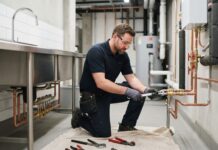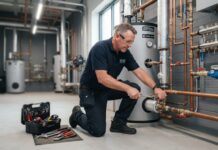
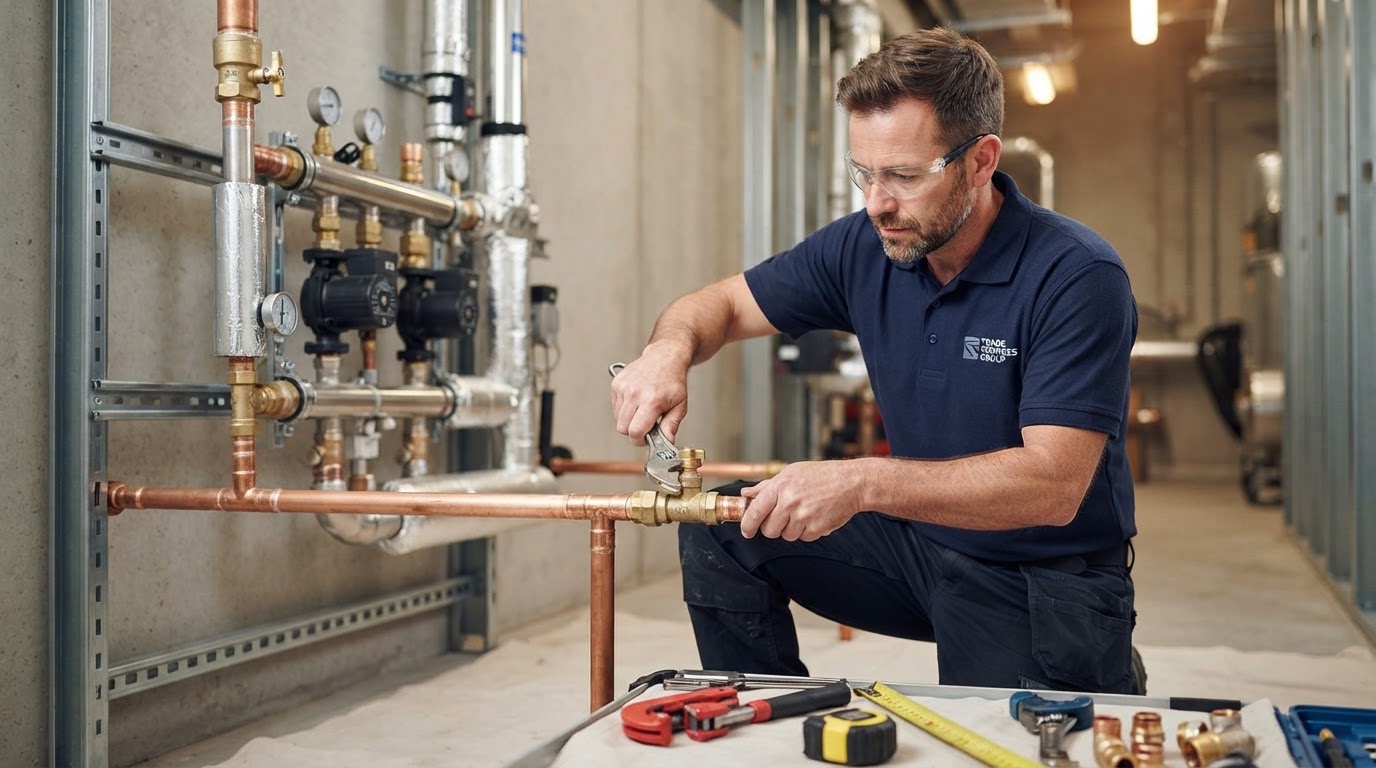
Plumbing equipment buying decisions directly affect project schedules, compliance risk and long‑term operating costs for commercial jobs. This guide gives commercial plumbers and procurement managers in Melbourne’s Northern Suburbs a step‑by‑step buying framework plus vetted online suppliers in Australia so you can order the right tools, fittings and fixtures with confidence.
We cover the equipment categories you need, how commercial requirements differ from residential, compliance and certification checks, an Australian online supplier comparison, local supplier profiles that service Melbourne’s northern suburbs, practical ordering tips, and maintenance best practices derived from trade experience. Read the short case studies and supplier walkthroughs to see how real contractors solved common procurement problems.
Next, we’ll detail the specific types of plumbing equipment every commercial plumber needs and why each item is chosen differently for commercial work.
Introduction to Plumbing Equipment for Commercial Use
Commercial plumbing projects demand more robust, higher‑capacity and code‑compliant kit than most residential jobs. While a domestic bathroom swap might be solved with a single adjustable wrench and a couple of certified fittings, commercial sites typically require specialised installation tools, higher‑flow fixtures, pressure‑rated materials and documented product certification.
Commercial plumbing tools and supplies include: heavy‑duty installation tools, pipework systems (copper, stainless, PEX, press‑fit), service valves and backflow prevention, high‑capacity sanitaryware and commercial water heaters, plus access panels and mechanical components for grease traps and stormwater drainage. Selecting the right plumber equipment means matching product specification to duty cycle (how often the asset will be used), chemical exposure, and serviceability expectations on site.
Australian plumbing safety and product standards (for example, WaterMark certification and AS/NZS standards) play a central role in supplier selection and product verification. For official guidance on national standards and building codes see the Australian Building Codes Board and for certification standards consult Standards Australia. Industry advice and trade guidance are available from the Master Plumbers Association.
Transition: With that regulatory context, below is a practical, itemised list of the tools and components you should stock for commercial works.
Types of Plumbing Equipment Every Commercial Plumber Needs
-
Pipe and tube cutting & preparation tools
Commercial crews should carry heavy‑duty pipe cutters for copper, stainless and PEX, plus powered tubing saws and bevelers. Pipe reamers, deburring tools and tube cleaning brushes prevent leaks and ensure proper joint seating on press and soldered joints. Choose cutters with replaceable wheels and spares availability.
Why: Faster, cleaner cuts reduce rework on large runs and improve joint life under high‑pressure commercial systems.
-
Press‑fit and crimping tools
Press systems (e.g., for copper and stainless) and heavy‑duty PEX crimping tools speed installation of long runs in commercial builds. Battery powered press tools with manufacturer‑matched jaws are standard on larger sites. Keep calibration documentation and spare batteries on the truck.
Note: Use only manufacturer‑approved fittings with press tools — mismatches can void warranties and fail certification checks.
For industrial scale equipment and deeper specification comparisons see industrial plumbing contractors guide.
-
Threading and tapping gear
Manual and powered threaders, thread gauges and high‑quality taps are essential for commercial mechanical services. Use hardened dies and maintain cutting oils for longer tool life. Metric and BSPT sizes are commonly required on Australian commercial sites—keep a full size set.
-
High‑torque wrenches and multi‑spanner sets
Large gate valves, mechanical couplings and flanged connections need impact or torque‑limited wrenches. Standard adjustable wrenches won’t reliably hold commercial fittings. Torque charts and calibrated wrench tracking are best practice for compliance and bolt integrity.
-
Pumping and testing equipment
Portable pressure test pumps, digital manometers, hydrostatic test rigs and pump‑out equipment are required for proving mains, fire services and hydronic circuits. Always keep test certificates and calibrate gauges as part of quality control.
-
Drain cleaning and CCTV inspection tools
Heavy‑duty power drainers, electric augers and camera inspection reels are standard for commercial maintenance and diagnostics. Invest in modular camera heads and durable reels to handle longer mains and to work with inspection reporting software.
-
Backflow prevention and water quality testing kits
Commercial sites often require installed backflow devices and scheduled testing. Carry certified replacement assemblies and certified test kits for potable water verification; keep WaterMark‑approved parts for compliance.
Note: Always record test certificates for property owners and regulators.
-
Sanitaryware and high‑flow fixtures
Commercial toilets, urinals, sensor taps, and heavy‑use sinks differ from domestic fittings in flow rate, trap design and vandal resistance. Choose commercial‑rated options with proven warranty and service back up.
For cap and fitting selection details consult the caps for plumbing guide to selection.
-
Grease traps, interceptors and stormwater equipment
Commercial kitchens and industrial processes require appropriately sized grease traps, oil interceptors and stormwater detention systems. Sizing must meet council and trade waste authority requirements; many councils require installed devices to be certified and documented.
Why: Undersized units cause non‑compliance and costly retrofits.
-
Hot water systems and commercial heaters
Commercial water heaters — instantaneous gas, large electric storage or commercial heat-pump systems — require trade‑specified accessories: expansion vessels, mixing valves and pressure relief valves sized to duty cycles. Gas appliances demand licensed gasfitting and strict compliance with gas standards.
For gas compliance and certification context see commercial gas plumber training and certification guide.
-
Fittings, valves and specialty connectors
Commercial jobs need robust gate, butterfly and ball valves, ductile iron fittings, and certified mechanical couplers. Stock styles: flanged, welded, push‑fit and compression couplings for fast field repairs. Keep spares of common sizes and manufacturer part numbers.
For larger industrial site requirements see industrial plumbing Melbourne services guide.
-
Personal protective equipment (PPE) and confined space kit
PPE — hearing, respiratory, chemical gloves, eye protection and confined space monitoring instruments — is non‑negotiable on commercial sites. Confined space rescue kits, gas detectors and isolation equipment must meet workplace safety regulations and be inspected regularly.
-
Consumables and parts inventory
Keep trade stock: O‑rings, gaskets, PTFE tape, thread sealants rated to potable water, sealants compatible with potable systems, ductile iron clamps, and various washers. For fast turnarounds, maintain a documented parts list matched to vehicle inventory levels.
See caps for plumbing guide to selection for cap sizing and selection rules.
-
Digital tools and asset tagging
Commercial projects benefit from digital asset tagging and QR coded manuals for installed valves and devices. Use cloud inventory and warranty tracking to manage maintenance and replacement cycles.
Transition: After identifying the kit, the next crucial step is evaluating what matters most when you actually buy it.
Key Factors to Consider When Buying Plumbing Equipment
Buying commercial plumbing equipment requires balancing compliance, durability, lifecycle cost and supplier reliability. Below are the key criteria and how to verify them in an Australian commercial context.
1. Compliance and certification
Ensure products meet Australian standards and carry required markings. WaterMark certification and relevant AS/NZS standards are required for many fixtures and materials. Check certification on product pages, datasheets and manufacturers’ declarations. For regulatory reference consult the Australian Building Codes Board and the Standards Australia guidance.
For an expanded look at compliance that impacts equipment choice see commercial plumbing guide to services and compliance requirements.
How to check certification
- Request product technical data sheets (TDS) and certificate numbers. Verify certificate numbers with the certifying body.
- Confirm potable‑water suitability and WRAS/WaterMark approval where applicable.
- Check manufacturer recall notices and safety data sheets (SDS).
2. Duty rating and materials selection
Commercial systems run longer and under greater mechanical stress than residential ones. Choose materials tested for the load, temperature and chemical exposure expected: stainless steel for corrosive environments, ductile iron for buried mains, and PEX or copper for distribution depending on water quality concerns. Manufacturer lifecycle tests and corrosion resistance data should guide selection.
3. Warranty, service and spares strategy
Prioritise suppliers with transparent warranties and local service support. A multi‑year manufacturer warranty is valuable only if the supplier has a local returns and service process. For example, buy boilers or instantaneous heaters from suppliers who provide local commissioning and spare parts. Record warranty registration details at point of purchase.
4. Supplier reliability and trade accounts
Trade customers should use suppliers that offer trade accounts, bulk discounts, priority dispatch and holds‑for‑collection (HFC) at local branches. Trade accounts provide invoice histories and simplify compliance documentation. Evaluate supplier reliability through delivery track records, SLA terms, and references from other commercial contractors.
5. Total Cost of Ownership (TCO)
Consider initial price plus installation time, expected maintenance costs, spare parts pricing and energy consumption (for heaters and pumps). A cheaper valve that requires early replacement will cost more in labour and downtime; evaluate TCO over the expected lifecycle.
6. Compatibility with existing systems
Ensure new equipment interfaces with installed systems—thread types, flange standards, control signals, and site service access. Mismatched connections cause onsite delays and bespoke adaptor costs.
7. Delivery logistics and lead times
Large or heavy equipment may attract freight surcharges and require site cranes or lift‑access coordination. Confirm delivery windows, tailgate or liftgate requirements and parking restrictions in Melbourne Northern Suburbs. When ordering, request delivery confirmations with an estimated time of arrival (ETA) and unloading instructions.
8. Sustainability and energy efficiency
Look for energy‑efficient pumps and water‑saving fixtures with verified labelling. Efficient equipment reduces operational costs and may meet council sustainability requirements. According to a 2024 industry report, specifying efficient water fittings can reduce building water use by up to 25% on commercial sites.
9. Insurance and liability considerations
Buy equipment whose failure modes align with insurance coverages. For high‑risk items (pressure vessels, backflow devices), choose suppliers who offer traceable documentation and certified installers to avoid liability gaps.
10. Specialist training and certification
Some equipment (commercial gas appliances, press‑tool systems, backflow devices) requires trained installers for warranty validity. For training and certification pathways relevant to gas plumbing see the commercial gas plumber training and certification guide.
Transition: With these buying factors in mind, next is a practical comparison of online plumbing suppliers that service Australia so you can pick the best fulfilment channel.
Comparing Online Plumbing Supplies in Australia: What to Look For
This comparison focuses on common selection criteria: stock depth, online ordering features, delivery, trade account benefits, pricing transparency and customer support. The table below summarises core supplier traits to compare quickly when you’re procuring for commercial jobs in Melbourne’s Northern Suburbs.
| Supplier | Stock & product range | Delivery options | Trade accounts & discounts | Pricing transparency | Notes (service area / local branches) |
|---|---|---|---|---|---|
| Reece | Extensive commercial range: sanitaryware, pipe, valves, hot water | Next‑day metro, pick‑up, bulk freight | Trade accounts, credit terms, bulk pricing | Catalogue pricing with online quotes | National network, strong Melbourne branch presence |
| Tradelink | Commercial fittings, fixtures, backflow devices | Metro delivery, click & collect, specialist freight | Trade pricing, account management | Transparent catalogues, show volume discounts | Large footprint across Victoria with local branches |
| Bunnings Trade & Commercial | Good for consumables, tools, basic fixtures | Next‑day metro delivery, kerbside | Trade accounts via Bunnings Commercial | Competitive for general consumables | Wide branch network; not all specialist items stocked |
| B P Plumbing Supplies | Specialist commercial components and parts | Metro delivery and local pick up | Trade account options available | Pricing varies; specialised quotes for projects | Good specialist stock depth — see supplier guide |
| Specialist Online Retailers | High‑end fixtures, sensor taps, commercial HVAC parts | Courier delivery, often longer lead times | Some offer trade portals | Varies; premium pricing for niche brands | Often import‑led stock; check ETAs |
Transition: Below we unpack the table entries, offer practical checks when comparing suppliers, and highlight how to use trade accounts and delivery options to reduce downtime and cost.
Stock availability and SKU depth
Commercial projects benefit from suppliers with deep SKU coverage. Check multi‑branch availability: a product may be available in Sydney but not in Melbourne. For reliable project planning, request stock holds or order reserves. For specialist components (e.g., grease trap spare parts), ensure the supplier retains common spare part SKUs.
Delivery speed, freight handling and local collection
Delivery options should match on‑site constraints. In the Melbourne Northern Suburbs confirm whether the supplier offers tailgate delivery, pallet drop, or requires an appointed truck. Some suppliers offer timed delivery windows for an extra fee but that can save wait times on busy sites.
Trade portal features and invoice management
Evaluate online portals for order history, digital invoices, warranty registration, and saved project lists. Good portals speed reorder and establish procurement audit trails for compliance.
Price comparators and quoting
Use supplier quoting tools for project tenders. Where suppliers publish price lists, request formal project quotes that include delivery, GST, and potential bulk discounts. For large projects, ask for fixed‑price purchase orders to lock rates for a period.
For tips on finding discounted lines and sales event timing see plumbing sale guide to sourcing discounted equipment and parts.
Use regional buying guides as a benchmark when comparing prices outside Victoria — for example plumbing supplies Wangara buying guide illustrates how mainland regional pricing and freight affect total cost.
Customer service and returns
Check RMA (return merchandise authorisation) policies and how warranty claims are handled. Transparent return policies with local pickup avoid on‑site delays. Document a supplier’s standard RMA lead times before committing to a large order.
Online reviews and trade references
Review aggregator scores are useful but request trade references from suppliers for recent commercial projects. Speak to local contractors in Melbourne’s Northern Suburbs to confirm performance on similar job sizes — see case studies below for real examples.
Pricing transparency & hidden costs
Watch for freight surcharges, pallet handling, call‑out fees for delivery or storage fees for staged deliveries. These can significantly alter unit economics on large orders.
Transition: With the comparison framework set, the next section highlights top online suppliers that actively serve Melbourne’s Northern Suburbs and their practical strengths.
Top Online Suppliers for Plumbing Equipment Serving Melbourne Northern Suburbs
Below are curated supplier profiles tailored to commercial plumbers and businesses in Melbourne’s Northern Suburbs. Each profile lists practical service strengths, trade benefits, and a short note on local logistics.
-
Reece
Profile: Nationwide leader with broad commercial catalogues covering sanitaryware, heating, waterworks and specialist mechanical items. Reece supports trade accounts, project quoting and has extensive Melbourne branches for same‑day pick up. Their online portal allows pre‑booking of delivery slots and stores purchase history for warranty evidence.
Strengths: Deep SKU range, local service branches, well‑documented product certification and local technical support for commissioning.
Use case: A commercial fit‑out in Thomastown required next‑day delivery of sensor taps and certified mixing valves; Reece’s local depot fulfilled a partial order that saved the fit‑out from schedule slippage.
For comparative service and cost analysis outside Victoria, see Commercial plumber Perth services guide.
-
Tradelink
Profile: A reliable choice for fittings, backflow devices and commercial fixtures. Tradelink’s trade accounts offer volume discounts and local branch pickup. Website allows checking real‑time stock for many branch locations around Melbourne’s northern suburbs.
Strengths: Good balance of catalogue depth and branch availability, straightforward RMA process.
-
Bunnings Trade & Commercial
Profile: Best for consumables, tools and rapid access to common items. The Bunnings Trade portal supplies bulk ordering and local delivery options but may not carry some specialist commercial assemblies or certified backflow devices.
Strengths: Rapid availability of consumables, widely distributed branches in Melbourne’s north for urgent pickups.
-
B P Plumbing Supplies
Profile: Specialist supplier with detailed product ranges for commercial parts and project quoting. Frequently used by local contractors in the Northern Suburbs for hard‑to‑find fittings and OEM parts. See the deep dive at B P plumbing supplies detailed guide.
-
Specialist Online Retailers & Brand Dealers
Profile: Online specialists carry premium sensor taps, commercial kitchen fittings and imported components. These suppliers are useful when specific model numbers or brand warranty registration is required; expect longer lead times and import freight.
Strengths: Access to niche brands and high‑end finishes, direct manufacturer support for complicated warranties.
-
Local Independent Merchants and Wholesalers
Profile: Melbourne’s northern suburbs host independent merchants that blend online ordering with local dispatch. Independents often offer personalised service, can source non‑catalogue items and hold small but critical spares locally.
Strengths: Personalized account reps, quick local pickups and flexible returns for tradespeople.
For a perspective on local service pricing and urban delivery nuances see Plumber Melbourne CBD service guide.
-
National and Large‑Scale Suppliers
Profile: Large wholesalers and manufacturers supply multiple project branches and can supply bulk orders and project staging. These suppliers also provide frameworks for long‑term maintenance contracts and spare parts logistics.
For insight on large suppliers consider biggest plumbing companies in Australia guide.
Transition: Below are practical tips for ordering online so purchases arrive on time and meet compliance requirements.
Tips for Ordering Plumbing Equipment Online Successfully
Ordering online for commercial projects needs to be systematic: confirm specifications, allow for lead times, manage delivery logistics and document all warranty and certification details. Follow this step‑by‑step process and checklist to reduce ordering errors and site delays.
How‑to steps
- Define the specification — capture manufacturer part numbers, sizes, pressure ratings, materials, and certification numbers before you order.
- Request datasheets — require TDS and certification scans as attachments to the order or quote.
- Compare like‑for‑like — check duty ratings and warranty terms, not just price.
- Use trade accounts — set up trade accounts early to access credit terms, purchase orders and project invoicing.
- Confirm delivery constraints — include site delivery instructions, parking permits, and required lift/crane access in the purchase order.
- Stagger deliveries — for large projects stage deliveries to avoid storage costs and material damage.
- Keep order confirmations — save supplier confirmations, shipment tracking, and certificates in a cloud folder linked to the project.
- Inspect on receipt — check serial numbers, certificates and packaging before signing off on delivery.
- Register warranties — many manufacturer warranties require registration within weeks of purchase.
- Plan for returns — know the supplier RMA process and associated costs prior to ordering.
When ordering specialist parts, review supplier guides like B P plumbing supplies detailed guide to confirm part compatibility and project pricing.
Ordering checklist (printable)
- Part number and manufacturer
- Material and rating
- Certification numbers and TDS attached
- Supplier quote with freight and terms
- Delivery window and site instructions
- Warranty registration steps
- Item inspection upon receipt
Transition: Once equipment arrives, storing and maintaining it correctly extends lifespan and reduces lifecycle costs; here’s a practical maintenance plan.
Maintaining and Storing Plumbing Equipment to Maximise Lifespan
Practical maintenance and storage routines protect capital equipment, reduce failures and maintain compliance for commercial installations. The following tips are grounded in trade experience working on Melbourne Northern Suburbs projects.
-
Clean and dry storage
Store valves, fittings and tools in dry, ventilated spaces to avoid corrosion. Use pallet racking for boxed stock and keep metal parts off concrete floors. For stainless items, avoid contact with carbon steel to prevent galvanic staining.
-
Corrosion prevention
Apply recommended passivation treatments to stainless steel where required. For ferrous items, keep coatings intact and inspect for surface rust monthly. Use desiccants in sealed toolboxes if you work in high‑humidity areas.
-
Tool calibration and servicing
Calibrate torque and press tools annually or per manufacturer rules. Keep calibration certificates in a cloud folder tied to each tool. Replace worn jaws, belts and batteries before site failure.
-
Consumable rotation
FIFO (first in, first out) for consumables prevents age‑related failure. Label boxes with purchase date and project use to avoid using degraded sealants or tapes.
-
Spare parts kits
Maintain vehicle‑mounted spare kits for common valves, couplings and gaskets. A basic on‑truck kit avoids emergency downtime and reduces costly call‑backs.
For repair workflows and scheduled maintenance detail see commercial plumbing maintenance guide.
-
Service records and asset tagging
Tag critical components and log service dates, replacement parts and test certificates. QR tags linked to digital records speed fault diagnosis for maintenance contractors.
-
Safe chemical storage
Store adhesives, solvents and chemical cleaners in approved cabinets away from heat and in labelled containers. Keep SDS sheets accessible.
-
Training and competence
Ensure staff are trained on equipment care — e.g., correct use of press tools and backflow testing equipment. Poor technique causes premature wear and voids warranties.
For guidance on maintenance service options see commercial plumber service guide.
-
Lifecycle replacement planning
Create replacement schedules based on manufacturer MTBF (mean time between failures) and local experience. Replace high‑use items proactively rather than reactively to avoid service disruptions.
Transition: Below is a concise summary and clear next steps to start purchasing with confidence.
Summary and Next Steps for Purchasing Plumbing Equipment
Choosing the right plumbing equipment for commercial projects in Melbourne’s Northern Suburbs requires a structured approach: specify duty and certification, prioritise supplier reliability, use trade accounts and confirm delivery logistics. Verify WaterMark/AS/NZS compliance, collect TDS and warranty registration documents, and maintain an on‑site spares strategy to reduce downtime.
Next steps:
- Use the equipment list in this guide to create a project‑specific procurement pack (part numbers, certifications, delivery needs).
- Set up trade accounts with at least two national suppliers (e.g., Reece, Tradelink) and one specialist local merchant for spares.
- Document delivery and installation instructions in purchase orders and retain all TDS and certificate copies for compliance audits.
Case study highlights from Melbourne Northern Suburbs (experience signals):
- Case 1 — A fit‑out contractor in Preston avoided a three‑day delay by ordering WaterMark‑certified sensor taps and mixing valves via a Reece trade account with next‑day pickup at the local branch. Warranty registration and TDS were attached to the PO, preventing compliance rework.
- Case 2 — A commercial kitchen install in Reservoir sourced a bespoke grease trap and replacement spare parts from B P Plumbing Supplies after local suppliers were out of stock. The supplier arranged palletised freight and provided a parts list that matched the council requirements, avoiding an expensive revision.
Final CTA: Start your procurement with a project pack — list your top 20 SKUs, request TDS and certificates, and open trade accounts with two local suppliers to secure lead times and minimise schedule risk.
Frequently Asked Questions
What types of plumbing equipment are essential for commercial plumbers?
Essential commercial equipment includes heavy‑duty pipe cutters and press/crimp tools, high‑torque wrenches, pressure testing pumps, CCTV drain cameras, backflow devices and certified sanitaryware. Also carry PPE, spare consumables and digital asset tagging tools for maintenance and compliance.
How do online plumbing supplies in Australia compare to physical stores?
Online suppliers offer broader catalogues and quoting tools, while physical branches provide immediate pickup and local returns. Use online portals for bulk quoting and trade accounts; use branches for urgent parts and inspections to avoid downtime.
What should I look for to ensure plumbing equipment complies with Australian standards?
Check for WaterMark approval, AS/NZS standard references on the TDS, and manufacturer certification numbers. Verify certificates with the issuing body and request conformity declarations and SDS for hazardous items.
How can I order plumbing equipment online safely and efficiently?
Define exact specifications and part numbers, request TDS and certificates, use trade accounts for invoicing, confirm delivery windows and site constraints, inspect goods on arrival and register warranties promptly.
How much does commercial plumbing equipment typically cost in Melbourne?
Costs vary widely: basic commercial fittings start from tens of dollars, specialist mechanical devices and heaters range from hundreds to several thousand. Project quotes and bulk discounts significantly affect unit prices; request formal quotes for accurate budgeting.
What are common problems when buying plumbing equipment online and how do I avoid them?
Common issues: incorrect specs, long lead times, hidden freight, and missing certification. Avoid these by confirming part numbers, requesting TDS, checking supplier freight terms and using trade accounts for purchase visibility.
How often should plumbing equipment be maintained or replaced?
Maintenance intervals depend on use: monthly inspections for high‑use valves and annual calibration for press and torque tools. Replace components based on manufacturer MTBF and observed wear; create scheduled service logs for critical assets.
How do I verify the quality and authenticity of plumbing equipment purchased online?
Verify by requesting TDS, certificate numbers and manufacturer warranty registration. Cross‑check certificate numbers with certifying bodies and purchase from reputable trade suppliers that provide documented returns and local support.