Plumbing business ownership in the Melbourne Northern Suburbs can be a profitable, resilient trade if launched with the right compliance, equipment and budgeting. This guide takes you step-by-step through startup requirements, a transparent cost breakdown tailored to the local market, and practical first-year actions so you can start a plumbing business with confidence.
Introduction to Starting a Plumbing Business
Starting a commercial plumbing business involves more than trade skill; it requires understanding business essentials, regulatory requirements, equipment investment and a local marketing plan. The Melbourne Northern Suburbs market is diverse—industries, retail strips and older housing stock create steady demand for commercial and light-industrial plumbing services. This guide focuses on actionable startup steps and realistic cost expectations tailored to that market while assuming you already have basic plumbing experience.
You’ll get a clear startup checklist, the licensing essentials you must meet, an equipment and vehicle outfitting plan, insurance and risk management advice, hiring considerations, marketing strategies and a line-by-line cost table to build your initial budget. A hypothetical Northern Suburbs startup scenario is included to show how numbers come together in practice.
Transition: Next, we’ll cover the legal and regulatory obligations that underpin a safe and compliant plumbing business launch.
Legal and Regulatory Requirements for a Plumbing Business Startup
Complying with local, state and federal rules is mandatory before trading. Follow this step-by-step checklist to ensure your commercial plumbing company meets the baseline regulatory obligations for Melbourne (Victoria).
- Trade qualification & registration
- Hold the applicable plumber’s licence or be employed by a licensed supervisor if you’re still completing apprenticeship requirements.
- Gas fitting or backflow work requires additional endorsements—check state criteria.
- Business registration
- Apply for an Australian Business Number (ABN).
- Decide on a business structure (see next section).
- Register your business name with ASIC if trading under a name other than your personal name.
- Tax registrations
- Register for GST once turnover is expected to exceed the threshold (current threshold: $75,000).
- Local permits and council approvals
- For commercial jobs, local council plumbing permits or building permits may be required.
- Inspections and compliance records
- Maintain job records, test certificates (for backflow, gas) and compliance documentation as required by Victorian Building Authority (VBA) and local councils.
- Workplace safety
- Comply with WorkSafe Victoria requirements: risk assessments, safe work method statements (SWMS) for higher-risk tasks, and training records for staff.
- Waste disposal and environmental rules
- Follow EPA Victoria guidelines for disposing of hazardous materials (e.g., petroleum residues, contaminated water).
How-to directions for the registration process (step-by-step):
- Gather ID, trade certificates and employer references.
- Apply for an ABN via the Australian Business Register—go to the ABR portal and follow “Apply for an ABN”. Australian government business.gov.au
- If trading under a business name, register it via ASIC Connect—select “Register a business name”.
- Decide on tax registrations: complete GST registration at the same time if turnover will exceed the threshold.
- Check Victorian licensing: contact the Victorian Building Authority or visit the trades certification portal to confirm your plumbing licence endorsements.
- Apply for any local council permits required for commercial projects—most councils publish permit checklists on their websites.
- Establish a compliance folder (physical or digital) with licences, SWMS, insurance certificates, test certificates and job reports.
Directional note for screenshots: when using the ABN portal, click “Apply for an ABN” → complete “Type of applicant” → use “individual” or “organisation” as appropriate → verify identity via ID documents. For ASIC Connect, go to “Business names” → “Apply” → follow prompts to reserve and register a name.
Link to deeper pillar content on commercial compliance: commercial plumbing guide to services and compliance requirements
Transition: With regulatory basics in hand, pick the right legal structure to match your risk profile and growth plan.
Choosing the Right Business Structure and Registration
Choosing between a sole trader, partnership, trust or company changes your legal exposure, tax obligations and administrative load. Below is a compact comparison to help decide which fits a commercial plumbing startup in Melbourne Northern Suburbs.
| Structure | Liability | Tax treatment | Admin & cost | Best for |
|---|---|---|---|---|
| Sole trader | Unlimited personal liability | Personal tax rates on profit | Low; ABN & business name registration | Single operators, low-risk clients |
| Partnership | Joint unlimited liability | Each partner taxed on share of profit | Moderate; partnership agreement advised | Two or more co-owners sharing workload |
| Company (Pty Ltd) | Limited to company assets (directors may have personal exposure) | Company tax rate on profits; dividend rules apply | Higher; ASIC fees, compliance, corporate tax returns | Growing/commercial contracts, hiring staff, high-risk work |
| Trust | Trust assets separate; trustees have obligations | Flexible distribution of income; complex | High; legal setup, trustee obligations | Asset protection, tax planning for families |
Explanatory prose: For many Northern Suburbs commercial plumbing startups, the choice comes down to sole trader vs company. A sole trader setup is the quickest and cheapest to register—ideal if you’re the only worker and taking small commercial jobs. A company (Pty Ltd) is recommended when bidding for larger commercial contracts, hiring staff, or when you want clearer separation of personal and business assets. Company structures have more rigorous reporting and ASIC fees but can offer tax advantages and are often preferred by larger clients or for subcontract tendering.
Tax considerations: Companies pay company tax on profits; sole traders pay personal income tax. If you expect to exceed the GST threshold ($75,000), budget for GST reporting and quarterly BAS lodgements. Speak with an accountant to model cashflow and tax outcomes by structure.
Registration steps summary:
- Decide structure—assess liability tolerance and growth plans.
- Register ABN and business name (ASIC) if required.
- If establishing a company, register with ASIC and obtain a company ABN/ACN; set up corporate bank accounts and director records.
- Register for PAYG withholding if you’ll hire staff, and for GST when required.
Transition: Once your structure is chosen, make sure you and any staff hold the correct trade licences and certifications.
Essential Training, Certifications, and Licensing
Holding the right trade qualifications and endorsements is a non-negotiable for a legitimate commercial plumbing business. Below are the primary certifications and training pathways you’ll need or should consider for commercial plumbing work in Victoria.
- Certificate III in Plumbing (or equivalent) — the core trade qualification demonstrating you are a qualified plumber. Employers or head contractors often require proof of this certificate.
- Certificate IV or additional supervisory qualifications — useful for business owners who will supervise apprentices or wish to step into contract management.
- Plumbing licence (Victorian Plumbing Licence) — required to legally perform plumbing work. Licensing covers drainage, sanitary plumbing and similar trades; apply via the VBA.
- commercial gas plumber training and certification guide — Gasfitting certification if you intend to carry out any gas work; involves separate practical and theoretical assessments and endorsements.
- Backflow prevention certification — required to test and certify backflow prevention devices on commercial premises. Training bodies and the relevant certification board list approved courses.
- Asbestos awareness & handling (where applicable) — many older commercial sites in Melbourne Northern Suburbs contain asbestos; complete required training and hold records.
- Confined space training — for work in pits and restricted access areas common on commercial/industrial sites.
- CPR and first aid — standard requirement for on-site health and safety.
- Continuing Professional Development (CPD) — maintain currency with changing regulations, new technologies and compliance expectations.
Why these matter: Clients—especially commercial property managers and large contractors—will request evidence of licences and endorsements before awarding contracts. Insurance policies often require staff to hold particular qualifications for cover to apply. According to a 2025 industry guidance note from trade certification bodies, maintaining up-to-date endorsements reduces claim denials and improves contract eligibility.
Training pathway notes:
- Complete apprenticeship or Certificate III via an RTO (registered training organisation).
- Apply for plumbing licence via VBA—submit trade qualifications, ID and experience logs.
- If offering gas services, complete gasfitting assessments and endorsements—see the linked commercial gas guide above.
- Keep digital copies of certificates in your compliance folder; supply copies to clients when tendering.
Transition: With people and licences sorted, you’ll need the right kit—tools, vehicle and workshop outfitting are the next major investment categories.
Core Equipment and Tools Required to Start a Plumbing Business
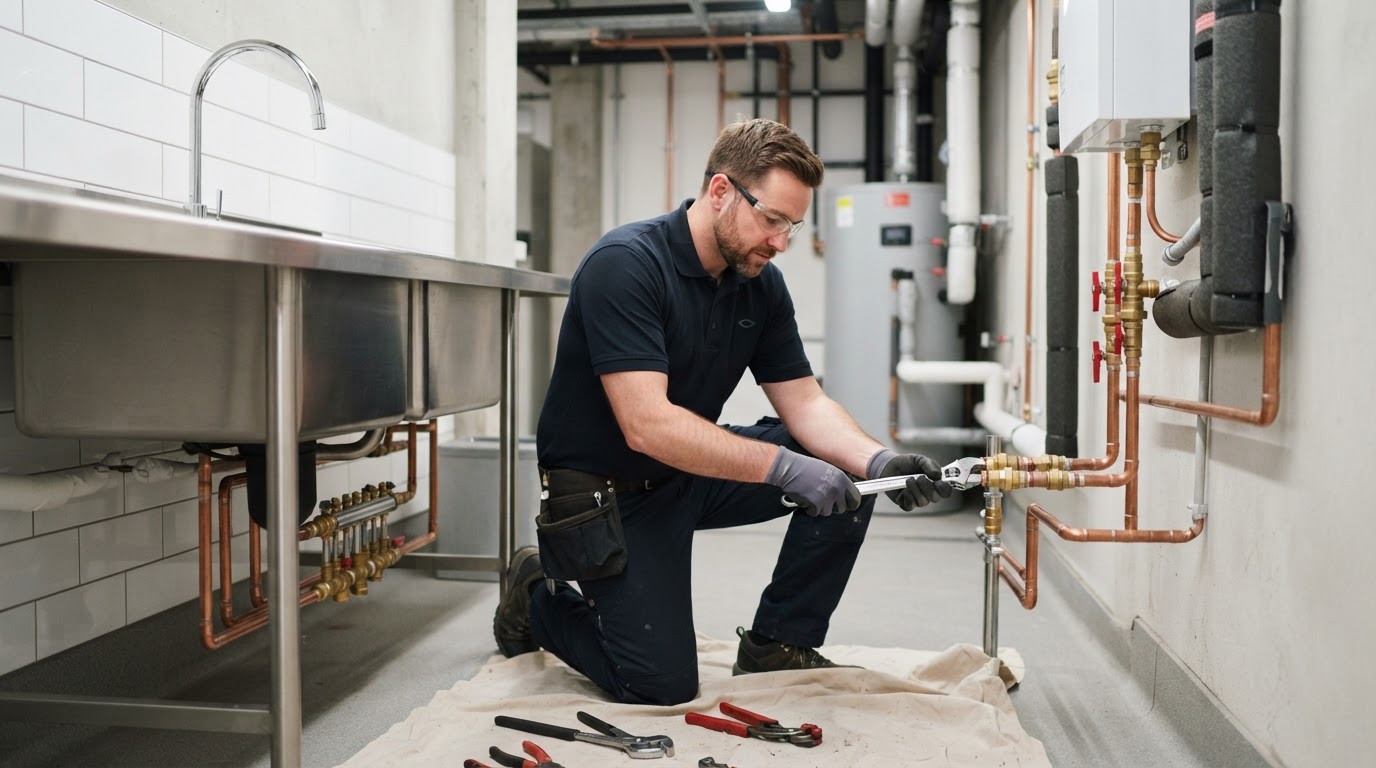
Outfitting a commercial plumbing business needs a mix of basic hand tools, specialised equipment, vehicle fit-out, safety gear and diagnostic tools. Below is a numbered list with typical cost ranges relevant to the Melbourne Northern Suburbs market and supplier references to help you budget accurately.
- Service vehicle (ute or van): $25,000–$60,000 (used to new). Choose a reliable van or dual-cab ute with secure lockable storage. Fit-out costs (racking, signage and toolboxes) add $3,000–$8,000.
- Basic hand tools kit: $1,500–$3,500. Includes spanners, pipe wrenches, adjustable wrenches, hammers, screwdrivers, basin wrenches and measuring tools.
- Power tools and battery systems: $1,200–$3,000. Cordless drills, impact drivers, reciprocating saws and battery chargers.
- Pipe cutting and joining equipment: $800–$3,000. Includes pipe cutters, threading tools, soldering kits, press-fit tools and PEX crimp systems.
- Drain clearing & inspection: $2,000–$12,000. Manual drain snakes ($200–$800), motorised drain machines ($2,000–$6,000) and inspection cameras ($2,000–$10,000) for commercial jobs.
- Hydro-jetting (optional for commercial focus): $20,000–$80,000 (industrial units). Consider renting for initial contracts. For advanced needs, review industrial equipment recommendations in the industrial plumbing contractors guide to services and costs.
- Testing & certification tools: $500–$3,000. Backflow test kits, pressure gauges, gas leak detectors and water quality testing kits.
- Personal protective equipment (PPE): $500–$1,500. Hard hats, hi-vis clothing, steel-cap boots, gloves, eye protection, and respirators where asbestos work may be present.
- Workshop essentials & storage: $1,000–$5,000. Shelving, workbenches, small compressor for tools and parts storage.
- Parts inventory start-up: $2,000–$10,000. Key fittings, valves, seals, flexible hoses and commonly used pipe sections.
- Office equipment & software: $1,000–$4,000. Mobile phone, laptop/tablet, quoting/job management software, invoicing and accounting software subscription.
- Signage and vehicle decals: $400–$2,000. Professional signage and vehicle livery to present as a commercial contractor.
- Specialised components & caps: $200–$1,500. For detailed component selection and cost factors, consult the caps for plumbing guide to selection and cost factors overview.
- Supplier sourcing: Use local suppliers to reduce delivery times. See B P plumbing supplies detailed guide to products and pricing and plumbing sale guide to sourcing discounted equipment and parts for pricing and discounts when buying in bulk.
Estimated initial equipment investment (practical range): $40,000–$120,000 depending on vehicle choice, whether you purchase hydro-jetting or camera gear upfront, and the depth of parts inventory. According to a 2024 industry report, most small commercial plumbing startups invest between $30,000 and $90,000 on tools and vehicle fit-out in their first year.
Tip: For start-ups with constrained capital, prioritise a reliable service vehicle, core hand tools, diagnostic camera (for quicker job triage) and a modest parts inventory. Consider leasing or renting large items like hydro-jetters until stable contract flows justify purchase.
Transition: Equipment brings risk—now plan insurance and risk management to protect your business and clients.
Insurance and Risk Management for Plumbing Startups
Insurance is a cornerstone of a commercial plumbing business—clients and contracts will almost always require it. Choose coverages that protect you from public liability claims, employee injuries and professional liability for workmanship on commercial sites.
Key types of insurance and typical annual premium ranges for Melbourne Northern Suburbs startups:
- Public Liability Insurance — Protects against third-party injury or property damage. Typical premiums: $800–$4,000 per year depending on cover level ($5M–$20M), turnover and claims history.
- Workers’ Compensation — Mandatory if you employ staff; premiums set by WorkSafe Victoria based on payroll and industry risk rating. Expect several percent of payroll; budget early and discuss rates with your insurer.
- Professional Indemnity Insurance — Covers advice or design work that leads to financial loss for a client. Typical premiums: $600–$2,500+ annually depending on limits and scope.
- Tool and Equipment Insurance — Covers loss/theft of mobile assets. Premiums vary; budget $300–$1,200 annually.
- Commercial Motor Insurance — Vehicle fleet or single van/ute cover: $1,200–$4,000+ annually depending on vehicle value and usage.
- Contract Works / Builders’ Risk — If you undertake larger commercial projects, clients or head contractors may require contract-specific cover for works-in-progress.
Risk mitigation best practice:
- Adopt and document safe work procedures (SWMS) for all high-risk tasks.
- Require appropriate licences and training for staff before assigning tasks.
- Inspect and service vehicles and high-risk equipment regularly.
- Use written contracts with clear scope, exclusions and payment terms.
- Keep a digital compliance folder and certificate copies to provide clients on request.
For insurance guidance and standards, consult the Insurance Council of Australia and the Australian Small Business and Insurance Council resources: Insurance Council of Australia and Australian government business.gov.au for general business insurance guidance.
Typical cost example (first year, small team): Public liability $1,500 + Tools insurance $600 + Motor $2,000 + Workers’ compensation (if paying $150,000 pa payroll) approx $3,000–$5,000 = $7,100–$9,000. Costs will vary by insurer, declared turnover and risk controls in place.
Transition: With protection in place, consider staffing options and associated labour costs for growth.
Staffing Considerations and Labor Costs
Deciding whether to hire employees, engage apprentices or use subcontractors shapes your payroll setup, employment obligations and cashflow. Here are practical options for an early-stage commercial plumbing business and typical costs in the Melbourne Northern Suburbs.
- Apprentices
- Cost: Apprenticeship wage rates vary by year of apprenticeship—approx $23–$35 per hour for first years, rising with progression. Employers can access incentives for hiring apprentices.
- Pros: Lower wage cost, builds loyalty and skill alignment with your business. Cons: Requires time for supervision and training.
- Qualified plumbers (employees)
- Cost: Fully qualified plumbers in Melbourne typically command $35–$55+ per hour wage (including on-costs). Salary plus superannuation, payroll tax, and leave entitlements increases total employer cost.
- Pros: Immediate productivity, lower supervision. Cons: Higher fixed costs and employment obligations.
- Subcontractors
- Cost: Subcontractor rates are negotiated—often 60–80% of labour component on a job. They invoice you for work completed.
- Pros: Flexible workforce, no payroll admin for subcontracted labour. Cons: Less control over quality and scheduling, potential tax/IR implications if misclassified.
- Labour laws and payroll setup
- Register for PAYG withholding and set up proper payroll software. Budget for superannuation (employer contributions), payroll tax (if threshold exceeded) and leave entitlements.
Hiring checklist:
- Define roles: field plumber, apprentice, estimator/office admin.
- Prepare employment contracts with clear duties and probation terms.
- Set up payroll and STP (single touch payroll) reporting.
- Budget for onboarding costs (PPE, induction, training time).
Transition: Staff and equipment are supported by a consistent flow of leads—next, create a marketing plan geared for local commercial customers.
Marketing, Branding, and Customer Acquisition Costs
Winning commercial work in the Melbourne Northern Suburbs means combining local SEO, trade networking, direct outreach and credible branding. Below are recommended tactics and approximate costs to attract and retain commercial clients.
Core marketing components and cost ranges:
- Website and local SEO: $2,000–$8,000 for a professional website; ongoing SEO $300–$1,200/month. Focus pages on commercial plumbing, service capability, licences and case studies. For examples of localised service positioning, review the plumber Melbourne CBD service guide for businesses and pricing and consider similar localization for Northern Suburbs suburbs like Preston, Coburg and Reservoir.
- Google Business Profile: Free to set up; manage reviews and local citations—budget small monthly time cost or $100–$400/month for management.
- Paid search (PPC): $500–$3,000/month initially depending on campaign reach. Bid on local commercial keywords and emergency plumbing terms.
- Trade directories & tender platforms: $200–$1,000/year. Listing on commercial tender sites and local trade directories increases visibility to property managers.
- Vehicle branding & local signage: $400–$2,000 one-off. High-visibility decals on your ute act as mobile advertising.
- Networking & B2B outreach: $0–$2,000. Attend local chamber of commerce events, property manager meetups and B2B expos. Budget for printed proposals and sample reports.
- Content & case studies: $300–$1,200 per case study or blog post if outsourced. Publish commercial project summaries demonstrating compliance and results.
- Customer relationship management (CRM): $20–$100/month for job & client management tools; essential for quoting and follow-up.
Marketing spend example for Year 1 (small commercial focus): Website $4,000 + Local SEO $600/month ($7,200/year) + Google Ads $1,200/month ($14,400/year) + Vehicle livery $800 + Networking $800 = approx $27,200 first-year marketing investment. Adjust scale to your cashflow and expected contract value.
For comparative positioning and pricing strategy in similar markets, study the commercial approach in other cities: commercial plumber Perth services guide and cost overview. Benchmark offerings, response times and service guarantees to shape your commercial propositions.
Transition: With marketing and operations planned, consolidate upfront and recurring costs into a comprehensive budget.
Detailed Startup Cost Breakdown and Budget Planning
This section provides an itemised cost table with explanations and a total estimated range for a typical Melbourne Northern Suburbs commercial plumbing startup. Numbers are presented as realistic ranges—select values best matching your planned service scope.
| Category | Item | One-off / Annual | Low estimate (AUD) | High estimate (AUD) |
|---|---|---|---|---|
| Business Registration | ABN, business name, ASIC fees | One-off/Annual | 100 | 1,000 |
| Legal & Accounting | Accounting setup, initial legal advice | One-off/Annual | 800 | 4,000 |
| Licensing & Certification | Licence applications, endorsements | One-off/Annual | 300 | 2,000 |
| Vehicle | Ute/Van purchase | One-off | 25,000 | 60,000 |
| Vehicle Fit-out | Racking, signage, toolboxes | One-off | 3,000 | 8,000 |
| Tools & Equipment | Hand tools, power tools, diagnostic gear | One-off | 10,000 | 35,000 |
| Specialised Equipment | Camera, drain machine, hydro-jet (optional) | One-off | 2,500 | 80,000 |
| Parts Inventory | Initial stock of fittings and valves | One-off/ongoing | 2,000 | 10,000 |
| Insurance | Public liability, motor, tools | Annual | 4,000 | 12,000 |
| Staffing | Wages (first 3 months for 1-2 staff) | Quarterly | 15,000 | 45,000 |
| Marketing | Website, SEO, ads, branding | One-off/annual | 6,000 | 30,000 |
| Office & Software | Phone, laptop, software subscriptions | One-off/annual | 1,200 | 6,000 |
| Working Capital | Cash buffer for 3 months operating costs | Reserve | 10,000 | 40,000 |
| Contingency | Unplanned costs (10–15%) | Reserve | 6,000 | 40,000 |
Estimated totals:
- Low-end startup (lean): approx $76,000
- High-end startup (fully equipped with specialised gear): approx $373,000
Notes on variance and financing options:
- These ranges reflect decisions such as buying vs leasing vehicles, renting equipment vs purchasing (hydro-jetters and inspection rigs), and the scale of your parts inventory.
- According to a 2024 industry report, typical small commercial plumbing startups budgeted $60,000–$120,000 to reach profitable operations in the first 12 months.
- Funding options: personal savings, bank business loans, equipment finance/lease, invoice financing, or partner investment. Government small-business grants or incentives for apprentices may reduce wage costs.
Hidden costs to plan for:
- Delayed invoices from commercial clients—budget for 30–60 day payment cycles.
- Equipment repairs and replacement cycles (drill batteries, camera cables).
- Permit fees and unexpected council conditions on commercial projects.
Local supplier references to refine tool and parts budgets: consult the B P plumbing supplies detailed guide to products and pricing and the plumbing sale guide to sourcing discounted equipment and parts.
Transition: After establishing your budget and funding, plan the practical next steps to launch and scale in your first year.
Summary and Next Steps for Aspiring Plumbing Business Owners
Launch checklist and timeline (practical 12-week start-up plan):
- Week 1–2: Decide business structure, apply for ABN, register business name (if required) and open business bank account.
- Week 2–4: Finalise trade licence and endorsements; collect qualification evidence and apply for plumbing licence via the VBA.
- Week 3–6: Purchase or finance service vehicle; plan fit-out; order core tools and PPE.
- Week 4–8: Set up insurance (public liability, motor, tools) and payroll systems; hire or contract initial staff if needed.
- Week 6–10: Build a basic website, set up Google Business Profile, and create marketing collateral and vehicle livery.
- Week 8–12: Start local outreach to property managers, facility managers and business owners; tender for small commercial jobs to build references.
Hypothetical Melbourne Northern Suburbs startup scenario (practical example):
Meet “Northern Suburbs Plumbing Co.”—a sole-trader founder with Certificate III, a second-hand van ($30,000), tool kit ($12,000), basic camera and drain machine ($8,000), parts inventory ($4,000), insurance ($6,000/year) and a lean marketing launch ($6,000). Initial working capital $15,000. Total first-year outlay ~ $81,000. After securing 5–8 recurring commercial maintenance contracts with average monthly invoicing of $12,000, cashflow becomes positive within 6–9 months. This example demonstrates conservative scaling tailored to the Melbourne Northern Suburbs market realities.
Growth tips and strategic next steps:
- Use early contracts to build case studies and client testimonials.
- Invest in a digital job management system to improve quoting speed and record-keeping.
- Consider subcontracting specialised tasks (e.g., industrial hydro-jetting) until you can justify purchase.
- Benchmark yourself against larger competitors—see the biggest plumbing companies in Australia guide and overview for growth models and service differentiation ideas.
- As you scale, add formal processes for quality assurance and recurring maintenance contracts—refer to the commercial plumbing maintenance guide to repair and costs and commercial plumber service guide for maintenance and costs for expansion strategies.
Final motivational note: launch with compliance first, a lean but reliable vehicle and tools, and a clear plan to win recurring commercial maintenance work. The Melbourne Northern Suburbs reward consistent service and prompt, documented work—build reputation early and scale deliberately.
Transition: Below are curated FAQs to answer common quick questions as you prepare to start.
Frequently Asked Questions
What is a plumbing business and how does it operate?
A plumbing business provides installation, repair and maintenance of water, drainage and gas systems for residential, commercial or industrial clients; it operates by bidding or quoting on jobs, scheduling crews, complying with licences/inspections, issuing test certificates and invoicing clients for completed work.
How does a sole trader plumbing business differ from a company structure?
A sole trader is simple to set up and taxed at personal rates with unlimited personal liability; a company (Pty Ltd) limits shareholder liability, has corporate tax obligations, higher compliance costs and is preferred for larger commercial contracts and hiring staff.
What are the essential licenses and certifications required to start a plumbing business?
Essential items include a Certificate III in Plumbing, a state plumbing licence, endorsements for gas or backflow where applicable, asbestos awareness and any confined-space or CPR training required for commercial tasks.
How do I start a plumbing business from scratch in Melbourne Northern Suburbs?
Steps: obtain trade qualifications, apply for an ABN and a plumbing licence, choose a business structure, insure the business, acquire a service vehicle and tools, set up invoices/payroll, then market to local commercial clients and property managers.
What are the typical startup costs for a commercial plumbing business?
Typical startup costs vary widely; expect a practical range of roughly $76,000 (lean) to $373,000 (fully equipped). Most small commercial startups budget $60,000–$120,000 in the first year, depending on vehicle and specialised equipment purchases.
How long does it usually take to get a plumbing business up and running?
A practical timeline is 8–12 weeks to register the business, secure licences, outfit a vehicle, purchase core tools and launch basic marketing; building reliable cashflow often takes 6–12 months depending on client acquisition speed.
What should I do if I encounter licensing issues when starting my plumbing business?
If licensing issues arise, contact the Victorian Building Authority or the relevant licensing body to clarify requirements, provide missing evidence, and consider engaging an industry-qualified consultant or legal advisor to resolve complex disputes.
How can I ensure the quality and safety of my plumbing services when starting out?
Ensure staff hold required licences, implement SWMS and safety checks, keep detailed job records and test certificates, maintain insurance, and use client feedback and periodic audits to continuously improve quality and safety practices.