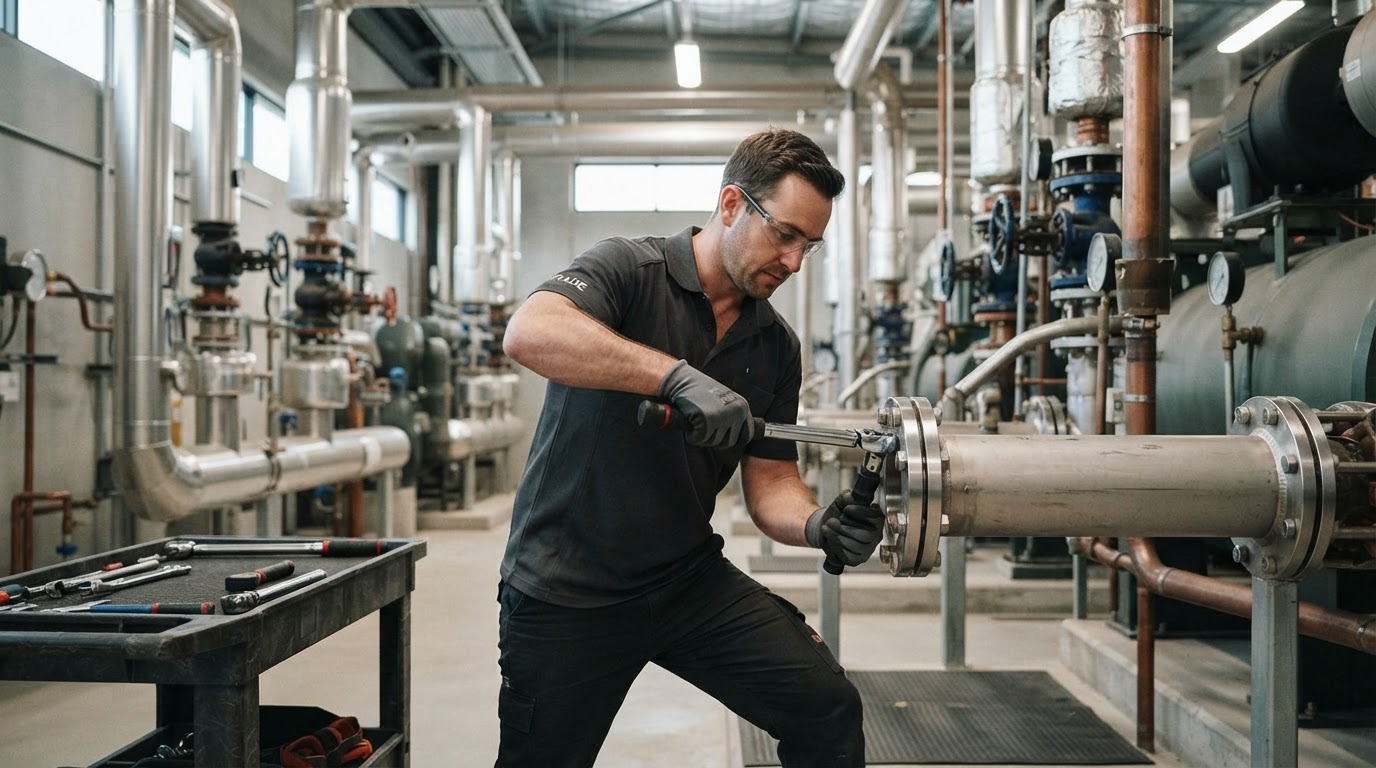
industrial plumbing Melbourne businesses rely on robust, compliant systems to keep production running and environmental risk managed. This guide walks facility managers through the services, contractors, regulations and maintenance practices specific to Melbourne’s industrial precincts—with a focus on the Northern Suburbs.
Overview of Industrial Plumbing in Melbourne
The term industrial plumbing systems describes the set of mechanical and hydraulic installations that deliver process water, remove waste and control fluids across factories, warehouses, food processing plants, and large commercial sites. In Melbourne these systems sit behind the city’s manufacturing and logistics activity—especially across the Northern Suburbs, where concentrated industrial zoning supports manufacturing, cold-chain operations and food processing.
Industrial water systems differ from domestic and standard commercial plumbing in scale, complexity and regulatory oversight. They typically include high-capacity supply mains, process plumbing for production lines, steam and condensate systems, specialised wastewater treatment, and extensive pipe infrastructure for hazardous or corrosive fluids. Mechanical plumbing teams coordinate with process engineers, electrical crews and environmental officers to ensure continuity of production and compliance with discharge and safety limits.
Melbourne industrial sectors with the highest plumbing demands include food and beverage processing, chemical and metal fabrication, cold storage and transport logistics. Northern Suburbs industrial zones—such as Campbellfield, Thomastown, Epping and Somerton—feature clusters of medium-to-large facilities where centralised water management and on-site treatment systems are common.
Key operational characteristics for industrial plumbing in Melbourne:
- High flow and pressure requirements for process lines and cleaning systems.
- Specialised materials to resist corrosion, abrasion and chemical attack.
- Integration with wastewater treatment and trade waste agreements with Melbourne Water.
- Frequent scheduled maintenance and asset management to minimise downtime.
Case example (Northern Suburbs, anonymised): a medium-sized food processor in Campbellfield replaced a century-old cast-iron distribution main with stainless steel and upgraded its trade-waste pre-treatment, reducing downtime by 18% and trade-waste surcharge incidents by half over a 12-month period. According to a 2024 industry report, targeted infrastructure upgrades can reduce unplanned shutdowns by up to 30%—a useful benchmark when prioritising capital works.
Core stakeholders for industrial plumbing projects in Melbourne include facility managers, process engineers, environmental compliance officers, and licensed industrial plumbing contractors. Projects commonly require permits, trade-waste approvals and coordinated shutdown windows to avoid production losses.
For readers comparing service models across Australia, see the commercial plumber Perth services guide for contrasts in regional approaches.
Transition: With the local landscape explained, the next section outlines the specific services industrial plumbers provide in Melbourne—so you can match needs to contractor capabilities.
Key Industrial Plumbing Services Offered in Melbourne
- Installation of process and distribution piping
Design and installation of high-capacity supply mains, process loops, and distribution headers using industrial-grade materials (stainless steel, DICL, HDPE). Installations include supports, expansion joints and isolation valves sized for operational flows.
- Wastewater and trade-waste systems
Design and implement treatment trains (screening, oil/water separation, pH neutralisation, biological treatment) to comply with trade-waste agreements and local discharge limits. Many contractors partner with environmental consultants for permit-ready designs.
- Stormwater and site drainage
Grated pits, oil interceptors, silt traps and attenuation systems tailored to impervious industrial sites; includes integration with on-site treatment and Melbourne Water discharge requirements.
- Preventative maintenance and planned shutdown works
Scheduled asset inspections, valve exercise programs, gasket replacements, and planned shutdown coordination to minimise production loss. Preventative programs are often customised by plant area and criticality.
- Emergency repairs and 24/7 response
Rapid response teams for ruptures, major blockages, pump failures and gas leaks. Industrial emergency work requires crews with confined-space, hazardous-chemical handling and permit-to-work training.
- Pump and valve supply / commissioning
Selection, installation and commissioning of industrial pumps (centrifugal, positive displacement), control valves, actuators and instrumentation integrated with PLC systems.
- Pipe rehabilitation and trenchless technologies
CCTV condition assessments, relining (cured-in-place pipe), directional drilling and micro-tunnelling to minimise excavation and plant disruption in congested yards.
- CCTV inspection and condition assessment
Video inspection to locate blockages, corrosion, and joint failures; commonly used before upgrades or relining. CCTV also supports trade-waste investigations and insurance claims.
- Thermal and steam systems
Steam reticulation, condensate handling, heat exchange piping and condensate recovery systems for facilities using steam in process heating; includes steam trap surveys and trap replacements.
- Specialist chemical and hazardous fluid handling
Containment piping, secondary bunding, corrosion-resistant materials and specialist fittings for acids, solvents and other hazardous process fluids; compliance with dangerous goods and bunding regulations.
- Water treatment and filtration systems
On-site potable treatment, reverse osmosis, filtration, softening and boiler-feed water treatment to protect process equipment and comply with product quality standards.
- Instrumentation and monitoring
Integration of flow meters, pressure sensors and remote monitoring (SCADA/IoT) for proactive condition monitoring and leak detection; many Melbourne contractors offer ongoing monitoring packages.
- Fabrication and prefabrication
Off-site prefabrication of skid-mounted pipework, manifolds and valve stations to reduce on-site labour and shorten shutdown windows; common in Northern Suburbs projects seeking quick turnarounds.
- Commissioning and validation
Hydrostatic testing, nitrogen testing, sterilisation (for food and beverage facilities), and recordable validation for production-critical systems.
- Decommissioning and asset disposal
Safe removal of redundant pipework, decontamination and disposal in line with environmental regulations and site safety procedures.
High-value services often combine multiple disciplines—mechanical, environmental and electrical—to deliver turnkey systems. Contractors who specialise in industrial work commonly provide cradle-to-grave services from design to commissioning.
Transition: Knowing the services available helps clarify which contractor profiles to prefer in Melbourne’s Northern Suburbs; next, we’ll examine how to choose the right contractor.
Selecting the Right Industrial Plumbing Contractor in Melbourne Northern Suburbs
Choosing an industrial plumbing contractor in the Northern Suburbs requires a structured evaluation to match facility needs, risk profiles and regulatory obligations. Below is a step-by-step approach with practical tips.
- Define project scope and criticality
Document process requirements, required downtime windows, hazardous materials and output-critical plumbing. Use a simple matrix classifying assets as critical, major or minor to prioritise contractor capabilities.
- Check licensing and certifications
Verify that the contractor holds a current Victorian plumbing licence and, where applicable, gas and trade-waste authorisations. Look for evidence of third-party certifications and training—particularly for confined space, high-risk work and hazardous chemical handling.
- Review experience in similar facilities
Request case studies or references specifically from Melbourne Northern Suburbs industrial zones. Prefer contractors who have completed work in your industry sector and understand local Trade Waste agreements and Melbourne Water interactions.
- Evaluate safety systems and WHS record
Ask for the contractor’s safety management system, incident rates, and subcontractor management approach. Confirm their compliance with WorkSafe Victoria guidance and permit-to-work procedures.
- Assess technical capability and equipment
Confirm the contractor’s access to CCTV inspection units, pipe relining equipment, prefabrication facilities and in-house welding/fabrication. For gas work, check specific gas competencies.
- Obtain staged quotes and compare scopes
Request itemised quotes that separate labour, materials, plant hire and testing. Avoid comparing low-ball bids that omit testing, traffic management or confined-space compliance—these costs are often added later.
- Check insurance and financial stability
Ensure contractors carry public liability, professional indemnity and workers’ compensation insurance appropriate to project scale. Ask for evidence of recent financial stability for larger installations to avoid mid-project insolvency risks.
- Confirm local presence and supply chains
Local Northern Suburbs contractors reduce mobilisation time and often have established supply routes for materials. Verify local warehousing, fabrication yards and relationships with Melbourne suppliers to shorten lead times.
- Review warranty, maintenance and handover terms
Confirm warranty periods for materials and workmanship, and whether the contractor offers ongoing maintenance agreements. Check documentation and as-built drawing handover commitments.
- Engage on project planning and shutdown coordination
Assess the contractor’s ability to develop a detailed project schedule with critical path milestones and contingency plans for unplanned discoveries. For complex sites, confirm experience in night or weekend works to reduce production impact.
Practical tips:
- Request a tender presentation from shortlisted contractors to assess communication and problem-solving approach.
- Insist on witness tests for pumps and control valves during commissioning.
- Use staged procurement: secure long-lead equipment early (pumps, large valves, heat exchangers) and allow contractors to pre-fabricate pipe skids off-site.
Step-by-step walkthrough: Assessing an industrial plumbing need for a typical manufacturing facility
- Gather existing documentation: site drawings, schematics, trade-waste agreements and maintenance logs.
- Conduct a visual site survey and CCTV inspection of critical drains and mains to detect corrosion or joint failure.
- Run flow and pressure tests at peak and off-peak times to establish operating envelopes (use temporary sensors if necessary).
- Identify critical assets (boilers, process loops, washdown headers) and map outage tolerances with operations.
- Create a staged intervention plan: emergency repairs, short shutdown upgrades, and long-term replacement projects prioritised by risk and ROI.
- Specify materials and monitoring needs; incorporate meter and alarm requirements into contract deliverables.
- Issue an RFT or request for quote with a clear scope, detailed acceptance tests and handover documentation required.
For gas-related credentials and contractor training details see the commercial gas plumber certification. For readers wanting deeper cost and contractor comparisons, consult the industrial plumbing contractors guide.
Large enterprises sometimes prefer national firms for multi-site standardisation—see the biggest plumbing companies in Australia overview for enterprise-level options.
Transition: After contractor selection, you must ensure work complies with Victoria’s regulatory framework—explained next with direct references to the relevant authorities.
Compliance Standards and Safety Regulations for Industrial Plumbing in Victoria
Industrial plumbing in Victoria falls under a regulatory framework covering building code compliance, licensed plumbing work, trade-waste management and workplace health and safety. Familiarity with these regimes is essential for project approvals and safe operation.
Key regulatory entities and standards:
- Victorian Building Authority — licensing, plumbing and drainage regulations, and compliance auditing.
- WorkSafe Victoria — workplace safety, high-risk work permits and incident reporting requirements.
- Melbourne Water — trade waste requirements, stormwater and discharge standards for metropolitan Melbourne.
Relevant codes and requirements (stat block):
| Standard / Authority | Primary focus | Notes (as of 2026) |
|---|---|---|
| Victorian Plumbing Code (VBA) | Licensing, approved work practices | Applies to all licensed plumbing work; permits and certificates required for major installations — according to the 2026 Victorian Plumbing Code. |
| AS/NZS 3500 series | Plumbing and drainage design standards | Sets design, testing and installation tolerances for industrial piping and fixtures. |
| Melbourne Water Trade Waste | Discharge quality and pre-treatment | Trade-waste agreements must be negotiated for industrial effluent prior to commissioning. |
| WorkSafe Victoria Regulations | WHS, hazardous substances, confined space | Requires permits, risk assessments and controls for high-risk plumbing activities. |
Licensing and certification essentials:
- All plumbing work must be carried out by a licensed plumber or an appropriately supervised apprentice under the Victorian Building Authority’s rules.
- High-risk and gas work require specific endorsements and documented competence—confirm via licence checks with the VBA.
- Trade-waste discharges typically need a pre-approval with Melbourne Water, with monitoring and reporting obligations embedded in the agreement.
Compliance inspections, commissioning and certification:
Major industrial plumbing projects will usually require staged inspections—rough-in, pressure testing, sanitary acceptance and final sign-off—documented with compliance certificates. For wastewater systems, Melbourne Water may require sampling and proof of treatment performance prior to accepting discharges.
Safety and environmental obligations:
- Adopt permit-to-work systems for confined space, isolation and hot-work operations—aligned with WorkSafe Victoria guidance.
- Implement spill containment, bunding and monitoring for hazardous fluid installations to meet both WHS and environmental protection standards.
- Maintain records for asset testing, valve and pump certifications, and trade-waste monitoring as evidence during audits.
Caveat: requirements may vary depending on facility size and industry type; always confirm specific obligations with the Victorian Building Authority, WorkSafe Victoria and Melbourne Water when planning works.
For a deeper statutory walkthrough, consult the site’s pillar on broader compliance guidance: commercial plumbing compliance requirements.
Transition: Compliance informs material choices and technology decisions—next we compare common industrial piping materials and technologies used on Melbourne projects.
Materials and Technology Used in Industrial Plumbing Projects
Material selection drives performance, lifespan and lifecycle costs for industrial systems. The following table compares common industrial piping materials used in Melbourne, followed by discussion on technology upgrades and sourcing.
| Material | Typical use | Pros | Cons |
|---|---|---|---|
| Stainless Steel (316/304) | Process lines, potable water, corrosive fluids | Corrosion resistance, longevity, hygienic for food industry | High material and fabrication cost |
| Ductile Iron (DICL) | Large water mains, high-pressure distribution | High strength, durable, cost-effective for large diameters | Susceptible to corrosion without coatings; heavy to install |
| HDPE (High Density Polyethylene) | Underground mains, chemical transfer, flexibility required | Flexible, corrosion-resistant, good for directional drilling | Temperature limits, fusion welding required for joints |
| PVC / uPVC | Non-pressurised drainage, some chemical lines | Low cost, lightweight, easy to install | Lower temperature and pressure tolerance |
| Carbon Steel | Steam, high-temperature lines, structural piping | Good strength at high temps, weldable | Requires coatings and corrosion protection |
| Fibreglass Reinforced Plastic (FRP) | Highly corrosive chemical lines | Excellent corrosion resistance, lightweight | Higher cost, specialist fabrication |
Discussion and sourcing notes:
Choosing between materials requires assessing chemical compatibility, temperature, pressure, abrasion and expected lifespan. Stainless steel is preferred in food and beverage for hygiene, while HDPE and DICL are common for large distribution mains. Carbon steel remains standard for steam reticulation. For specific fittings and caps consult the plumbing caps selection guide and suppliers like the B P network for pricing—see the plumbing supplies and pricing guide.
Technology upgrades commonly used in Melbourne projects:
- CCTV pipe inspection to assess gravity drains and sewer mains prior to excavation or relining.
- Smart flow meters and IoT-based pressure sensors to detect slow leaks and abnormal usage patterns.
- Automated valve actuators tied to plant SCADA systems for remote isolation during incidents.
- Advanced water treatment systems (RO, ultrafiltration) to support product quality or reduce trade-waste loads.
Trade-offs and lifecycle thinking:
Material initial cost vs lifecycle replacement: stainless steel often carries higher capex but lower maintenance and longer life in corrosive environments. HDPE offers lower installation costs for buried mains but may require replacement earlier under abrasive conditions. Consider whole-of-life costing and the impact of downtime for replacements when selecting materials.
Local supply and fabrication: Northern Suburbs contractors frequently source pipe and fittings from metropolitan distributors or maintain local fabrication yards to prefabricate manifolds and skids, reducing on-site labour and shortening shutdown windows.
Transition: Material and technology choices contribute to typical system failures and maintenance burdens; next we identify common challenges and mitigation strategies.
Common Challenges in Industrial Plumbing and How to Address Them
Industrial plumbing systems encounter recurring failure modes. Recognising patterns and applying targeted solutions reduces unplanned outages and extends asset life.
- Corrosion and material degradation
Solution: Use corrosion-resistant materials (stainless, FRP), specify protective coatings, install sacrificial anodes where applicable, and include routine corrosion-monitoring surveys.
- Blockages in drains and trade-waste lines
Solution: Regular CCTV inspections, install grease traps and oil interceptors sized to actual load, and implement operational controls to restrict inappropriate disposals.
- Pump and motor failures
Solution: Implement vibration and thermal monitoring, maintain spare pump units, schedule bearing and seal inspections, and ensure correct NPSH and suction conditions.
- Joint and gasket failures
Solution: Use correct gasket materials for chemical compatibility, torque bolts to manufacturer specs, and adopt leak-detection cameras during commissioning.
- Inadequate isolation and valve accessibility
Solution: Reconfigure pipework for accessible isolation points, install actuated valves for remote shutdown capability, and document lockout/tagout procedures.
- Trade-waste compliance breaches
Solution: Upgrade pre-treatment, install continuous monitoring where required, and maintain records for regulator audits.
- Confined-space and access hazards
Solution: Develop confined-space management plans, provide rescue equipment and training, and schedule higher-risk tasks during low-activity periods to reduce exposure.
- Ageing infrastructure leading to frequent repairs
Solution: Prioritise asset replacement via condition-based assessments and convert reactive maintenance budgets into capital upgrades guided by lifecycle analysis.
Troubleshooting techniques commonly used on Melbourne sites include CCTV diagnosis, tracer dye tests for leakage detection, acoustic leak detection for buried mains, and temporary bypass pumping to maintain operations during repairs.
Transition: Addressing these challenges requires a formal maintenance strategy—next, we provide best-practice maintenance steps tailored to industrial sites.
Maintenance Best Practices for Industrial Plumbing Systems
Preventative maintenance keeps systems reliable, reduces emergency interventions and controls long-term costs. A structured maintenance plan includes scheduled inspections, condition monitoring and lifecycle replacement planning.
- Develop an asset register
Catalogue pipes, valves, pumps, treatment units, drains and critical fittings with straight-line replacement costs and estimated service lives to prioritise work.
- Implement scheduled inspections
Perform weekly visual checks for leaks, monthly valve exercises, quarterly pump inspections and yearly CCTV surveys for drains and sewer mains.
- Use condition-based monitoring
Install vibration, temperature and flow sensors on critical pumps and mains. Analytics can flag deterioration before failures—according to a 2024 industry report, predictive maintenance can reduce unplanned downtime by up to 30%.
- Prioritise critical-path components
Focus maintenance resources on assets whose failure would shut production—valves, distribution headers and boiler feed systems—then expand coverage as budget allows.
- Create a spare parts strategy
Maintain critical spares (pump impellers, mechanical seals, common valves and gaskets) on-site or at a nearby warehouse to reduce response time for emergency repairs.
- Schedule planned shutdowns and pre-fabricate works
Where possible, prefabricate manifolds and large assemblies off-site and install during scheduled outages to compress downtime. Use a detailed critical-path schedule and test-run after re-commissioning.
- Track and review maintenance KPIs
Measure mean time between failures (MTBF), mean time to repair (MTTR), number of trade-waste incidents and maintenance costs per production hour. Review quarterly and adjust plans accordingly.
- Train operations staff for first-line checks
Equip operators with simple checklists and pressure/flow alarms to detect anomalies early and alert maintenance teams promptly.
- Engage contractors with maintenance agreements
Service level agreements give guaranteed response times and predictable pricing for emergency call-outs. For more detailed repair timelines and cost breakdowns see the commercial plumbing maintenance guide.
- Document and hand over as-built records
Ensure contractors supply full as-built drawings, test certificates and operation manuals for future maintenance and regulatory audits. For maintenance services and cost guidance, also see the commercial plumber service guide.
Caveat: maintenance frequency and specific monitoring choices should be tailored to facility size, process sensitivity and the types of fluids handled—requirements may vary depending on facility size and industry type.
Transition: Maintenance planning is increasingly complemented by sustainable and energy-efficient plumbing solutions—explored in the following section.
Sustainable and Energy-Efficient Plumbing Solutions for Industrial Facilities
Industrial facilities are under pressure to reduce water use, energy consumption and discharge impacts. Sustainable plumbing initiatives offer operational savings and regulatory benefits when aligned with business goals.
Practical sustainability measures implemented across Melbourne industrial sites:
- Water recycling and reuse — capturing process rinse water for reuse in subsequent cycles or for irrigation reduces potable water demand and trade-waste volumes.
- High-efficiency pumps and motor upgrades — replacing oversized or inefficient pumps with variable-speed drives lowers energy consumption and improves process control.
- Heat recovery and condensate return — capturing waste heat from condensate and heat exchangers reduces boiler fuel use in steam systems.
- Smart metering and leak detection — real-time flow monitoring identifies leaks early, reducing both water loss and potential product contamination risks.
- Low-impact materials and reduced chemical dosing — selecting materials and treatment regimes that minimise harmful chemical use while meeting process needs.
Example: A logistics cold-storage facility in Somerton installed condensate recovery and variable-speed drives on circulation pumps, cutting energy consumption for its water systems by roughly 12% in the first year. According to a 2023 environmental audit series, many Melbourne enterprises achieved 5–15% water or energy reductions through targeted plumbing upgrades.
Melbourne Water supports water-sensitive urban design and trade-waste reduction programs. For guidance on discharge and water conservation initiatives refer to the Melbourne Water resources at Melbourne Water.
Adoption strategy:
- Audit current water and energy consumption at the zone and equipment level.
- Identify ‘low-hanging fruit’ such as broken seals, leaking hoses and inefficient spray nozzles.
- Prioritise capital upgrades (pumps, heat recovery, treatment systems) using payback analyses and operational risk assessments.
- Implement monitoring and continuous improvement with KPIs tied to sustainability goals.
Transition: Bringing these elements together—services, contractor selection, compliance, materials and maintenance—delivers maximum reliability and value. The concluding section summarises the essential steps Melbourne facility managers should take.
Conclusion: Maximizing Value from Industrial Plumbing Services in Melbourne
Industrial plumbing in Melbourne, particularly across the Northern Suburbs, requires a coordinated approach: select contractors with relevant local experience and licences, plan upgrades using whole-of-life material analysis, and embed targeted maintenance and monitoring to reduce downtime and regulatory risk. Prioritise trade-waste compliance, adopt practical sustainability measures and ensure clear contractual terms for commissioning and handover.
Next steps: conduct a condition assessment (including CCTV where needed), shortlist contractors using the criteria above, and develop a staged capital and maintenance plan aligned to production windows. For regulatory specifics consult the Victorian Building Authority, WorkSafe Victoria and Melbourne Water early in project planning. Requirements may vary by facility size and industry—confirm obligations for your site.
Ready to proceed? Use this guide to scope your brief, assemble costed options from qualified Northern Suburbs contractors and schedule an initial site audit during a low-production window. Investing in the right materials, monitoring and contractor partnerships will deliver measurable reductions in downtime and operating costs—start planning your assessment today.
Frequently Asked Questions
What does industrial plumbing in Melbourne typically involve?
Industrial plumbing in Melbourne includes high-capacity water supply, process piping, wastewater and trade-waste systems, pumps, valves, onsite water treatment and specialised materials to handle corrosive or hazardous fluids—plus compliance with Victorian licensing and local trade-waste conditions.
How do industrial plumbers differ from commercial plumbers in Melbourne?
Industrial plumbers work at larger scale with specialised materials, higher pressures, chemical handling and integration with process controls; they require additional certifications, confined-space training and coordination with environmental and operations teams compared with typical commercial plumbers.
How can I choose the best industrial plumbing contractor in Melbourne Northern Suburbs?
Define scope, verify VBA licences and gas endorsements, review local Northern Suburbs case studies, assess safety systems and equipment capability (CCTV, prefabrication), request itemised quotes and confirm insurance and warranty terms before awarding work.
What are the common compliance requirements for industrial plumbing in Victoria?
Compliance includes licensed plumbing work under the Victorian Plumbing Code, adherence to AS/NZS 3500 standards, trade-waste approvals from Melbourne Water, and WHS controls aligned with WorkSafe Victoria for high-risk activities.
How long does an industrial plumbing installation usually take in Melbourne?
Installation times vary widely—simple pump installations can be days, while full distribution upgrades or trade-waste systems take weeks to months depending on complexity, prefabrication use, permits and required shutdown windows; cost estimates are indicative, not fixed.
What should I do if my industrial plumbing system experiences frequent blockages?
Start with CCTV inspections to pinpoint blockages, install or service grease and oil interceptors, review operational waste practices, and implement scheduled drain cleaning and monitoring to prevent recurrence.
Are there energy-efficient options available for industrial plumbing systems?
Yes: variable-speed drives for pumps, heat recovery from condensate, efficient pump selection, water recycling and smart metering reduce energy and water use; pilot audits identify highest-impact upgrades for your facility.
How can I verify that an industrial plumber in Melbourne is fully licensed and insured?
Request the plumber’s Victorian Building Authority licence number and insurance certificates (public liability, workers’ comp, professional indemnity). Confirm licences with the VBA and check training endorsements for gas and high-risk work.